7 Best Card-Based Roguelikes on PS5 You Must Play in 2026
As we navigate through 2026, the landscape of gaming has shifted dramatically. While AAA studios chase photulence, photorealistic ray-tracing, and massive open worlds, a quieter but much more profound revolution is happening in the “small-scale” genre. Card-based roguelikes have moved from niche indie curiosities to the most prestigious and strategically deep corner of the PlayStation 5 library.
As someone who has spent thousands of hours analyzing deck synergies, calculating probabilities, and enduring the heartbreak of a “one-HP” run, I have seen this genre evolve through several distinct eras. We have transitioned from the era of simple clones of Slay the Spire into an era of complex, multi-layered experiences like Monster Train 2, and even radical physics-based hybrids like Dungeon Clawler. Whether you are looking for a game that offers the intense, calculated strategic depth found in a high-stakes บาคาร่า session or the pure, unadulterated dopamine rush of a perfect combo, this guide is curated to help you find your next obsession.
In this deep dive, we will rank the top 7 card-based roguelikes available on PS5 today, evaluated based on mechanical depth, replayability, and critical acclaim from the global gaming community.
1. Balatro: The Undisputed King of Synergy (2024)
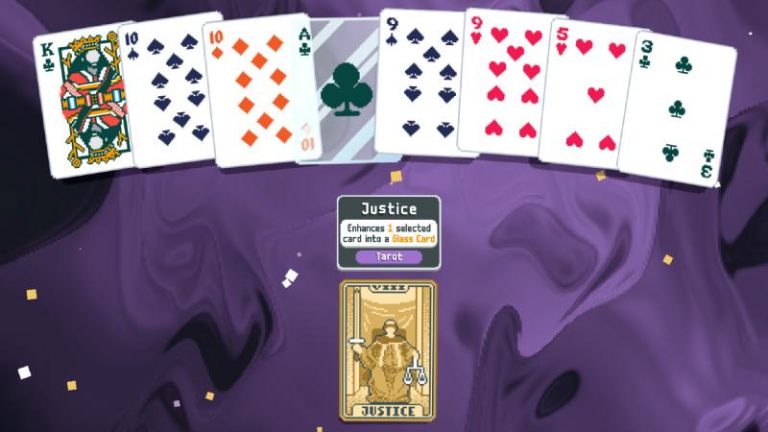
Metacritic Score: 91/100 | PlayStation Store Rating: 4.93/5
If you were a gamer in 2024, you remember the “Balatro Fever” that swept the globe. Even now, in 2026, Balatro remains the gold standard for what a deck-builder should be. It is a masterclass in “easy to learn, impossible to master.”
At its core, Balatro uses the familiar framework of poker hands. However, it strips away the traditional gambling anxiety and replaces it with pure strategic empowerment. You aren’t just playing hands; you are building a machine. Through the use of Joker cards, Tarot, and Spectral cards, you manipulate the very rules of the game to create astronomical scores.
The Expert’s Take: What makes Balatro so enduring is its mathematical elegance. The game rewards players who can recognize “synergy loops”—identifying when a specific Joker will trigger an exponential multiplier based on a certain suit or hand type. The recent addition of Challenge Modes and the high-difficulty tiers ensure that even veterans in 2026 still find new ways to fail—and more importantly, new ways to win. It is the ultimate “just one more run” experience.
2. Monster Train 2: The Pinnacle of Tactical Complexity (2025)
Metacritic Score: 90/100 | OpenCritic: 88/100
Following the massive success of its predecessor, Monster Train 2 arrived in mid-2025 and fundamentally changed how we view “tower defense deck-builders.” While the first game was a brilliant experiment, the sequel is a polished juggernaut that feels like a true next-gen experience on the PS5.
In this game, you aren’t just playing cards; you are managing a multi-floor locomotive engine of destruction. You must defend your hellish train from invading forces by placing units and spells on different levels of the train cars. The introduction of five new clans has expanded the strategic horizon so much that it feels like a completely different genre entirely.
Why It Stands a Chance in 2026: The most significant achievement here is the “Dual-Clan” system. By combining different clan archetypes, players can create defensive layers that feel impenetrable and offensive combos that are incredibly satisfying to execute. The release of the Destiny of the Railforged DLC in early 2026 has added a layer of late-game complexity that keeps the meta shifting constantly, ensuring that no two runs ever feel the same.
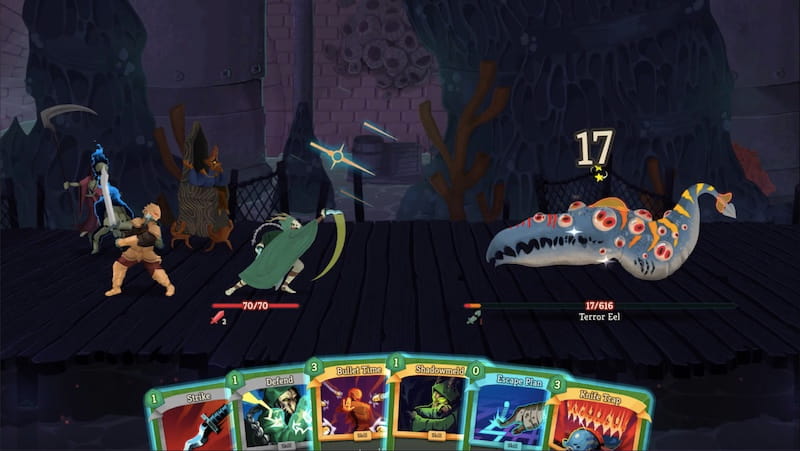
3. Slay the Spire: The Eternal Foundation (PS4/PS5)
OpenCritic Rating: Top 1% of all games | Verdict.games: 95/100
It is impossible to discuss card-based roguelikes without paying homage to the progenitor. Slay the Spire may be a legacy title—running via backward compatibility on PS5—but its influence is visible in every single game on this list. It is the “Big Bang” of the modern deck-builder era.
Even in 2026, as the gaming world waits for news regarding Slay the Spire 2, the original remains a mandatory play for anyone serious about the genre. It provides the fundamental DNA of deck-building: the art of the draft, the management of energy, and the terrifying realization that a single poorly chosen Relic can ruin an otherwise perfect run.
The Reliability Factor: There is a certain “trustworthiness” to Slay the Spire. Unlike newer titles that might rely on flashy graphics or complex physics, Slay the Spire relies on pure, unadulterated balance. It is one of the most “honest” games in the genre—it doesn’t hide its difficulty behind random luck; it challenges your ability to adapt to the cards you are given. For a beginner, this is the perfect classroom.
4. Inscryption: The Psychological Masterpiece (PS4/PS5)
Metacritic Score: 85/100 | PlayStation Store Rating: 4.73/.5
If Slay the Spire is a math textbook, Inscryption is a psychological thriller found in a dusty attic. This is not just a card game; it is an experience that breaks the fourth wall and stares back at you.
Starting as a dark, atmospheric card game played against a mysterious figure in a dimly lit cabin, Inscryption slowly unravels into something much larger—incorporating escape room elements and deep meta-narrative horror. It uses the deck-building mechanic not just as a way to play, but as a tool for storytelling.
The Experience: As a critic, what impressed me most was how the “deck-building” felt organic to the story. The cards aren’t just stats; they are trophies of your progression through a dark mystery. It is a rare game that manages to be both a brilliant card battler and one of the best horror stories of the last decade. It is unsettling, brilliant, and utterly unique.
5. Dungeon Clawler: A Physics-Based Revolution (2026)
Press Play Media Score: 7.7/10 | Released April 30, 2026
The newest entrant to our list is perhaps the most radical. Dungeon Clawler has completely abandoned the traditional “hand of cards” in favor of a physics-based claw machine mechanic. Developed by Stray Fawn Studio, this game asks: “What if your deck was actually inside a carnival machine?”
The Innovation: You play as a warrior rabbit who must physically use a mechanical claw to grab weapons, shields, and buffs from a moving pool of items in a claw machine. This introduces an element of “skill-based RNG” that traditional deck-builders lack. While the difficulty can spike unpredictably due to physics glitches or bad luck, the sheer novelty is incredibly refreshing for the 2026 market. The tactile satisfaction of the sound design—the clinking of metal and the dropping of items—makes it a sensory delight that feels much more “physical” than its peers.
6. Die in the Dungeon: The Dice-Building Evolution (2026)
GameBrief Score: 8.0/10 | Steam Rating: 93% Very Positive
In an era where everyone is trying to innovate, Die in the Dungeon took a different route by replacing cards with dice. Released in its full v1.0 form in May 2026, this game proves that “deck-building” is just one way to approach the roguelite formula.
By using 31 different types of dice, players engage in “dice-face modification.” Instead of adding a card to a deck, you are literally changing the numbers on your dice. When combined with 142 unique relics and a heavy emphasis on spatial positioning on the board, it creates a strategic depth that is much more cerebral than its card-based cousins.
The Strategic Depth: This is for the player who finds traditional deck-builders too predictable. The need to manage your position on the dungeon floor adds a layer of tactical movement that prevents you from just “clicking and winning.” It is a rewarding experience that rewards long-term planning and careful calculation, making it a favorite among hardcore strategy enthusiasts this year.
7. Griftlands: Narrative Meets Strategy (PS4/PS5)
Metacritic Score: 84/100 | OpenCritic: 87/100
Finally, we have Griftlands, a title from the legendary Klei Entertainment. While many games on this list focus purely on combat, Griftlands introduces a “Dual Deck” system: one deck for fighting and one deck for negotiation.
The Narrative Weight: In Griftlands, your ability to talk your way out of a situation is just as important as your ability to swing a sword. The decisions you make during dialogue branches can permanently alter the world and your character’s trajectory. It is the perfect choice for players who want their strategic card-play to be wrapped in a rich, gritty science-fiction narrative that feels meaningful and impactful.
Summary Table: Which Roguelike Should You Play?
To help you decide which of these titles to add to your PS5 library today, here is a quick reference guide based on player preference:
|
If you want… |
The best choice is… |
Primary Mechanic |
Difficulty |
|
Pure Addictive Synergy |
Balatro |
Poker Hands & Jokers |
High |
|
Complex Tower Defense |
Monster Train 2 |
Multi-floor Clan Combat |
High |
|
The Classic Experience |
Slay the Spire |
Traditional Deck-building |
Medium |
|
A Dark, Scary Story |
Inscryption |
Meta-horror & Puzzles |
Medium |
|
Something Totally New |
Dungeon Clawler |
Physics Claw Machine |
High |
|
Mathematical Dice Strategy |
Die in the Dungeon |
Dice Modification |
Medium |
|
Story and Negotiation |
Griftlands |
Combat + Dialogue Decks |
Medium |
Final Thoughts for 2026
As we look at the current state of the PS5 library, it is clear that the “Card-Based Roguelike” has matured. We have moved past the era of simple imitation and entered an era of radical experimentation. From the poker-inspired addiction of Balatro to the physics-defying chaos of Dungeon Clawler, the genre offers something for every type of strategist.
The beauty of the roguelike lies in the “run”—the knowledge that even in defeat, you have learned something new for the next attempt. Whether you are a veteran looking for a challenge or a newcomer looking to discover a new world, these seven games represent the absolute pinnacle of the genre in 2026.
Happy gaming, and may your draws always be legendary!