TNT championship is AEW’s most valuable title in 2026
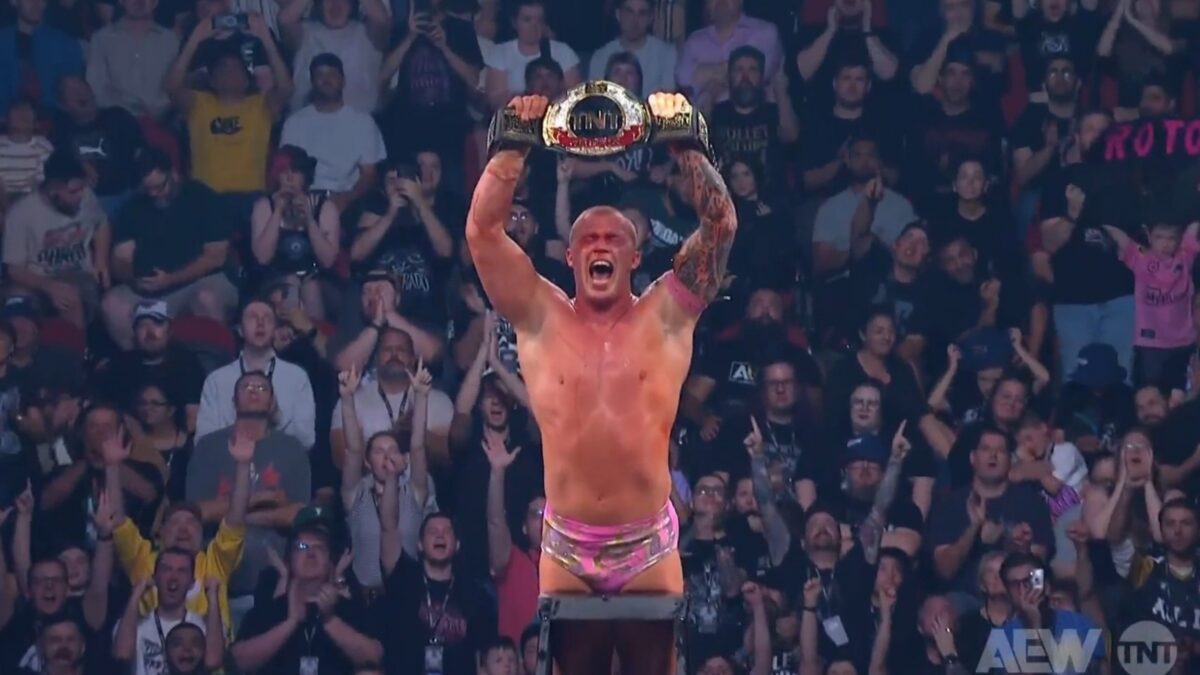
AEW’s motto doesn’t really mean much on its own. They’re just words Tony Khan probably pulled out of a hat, maybe his butt, but who could be sure?
The point is, without substance and action to qualify that statement, the phrase “where the best wrestle” is valueless. So, what does it mean for a company to utilize a motto like that?
In wrestling terms what is considered “best” is a matter of philosophy in how to approach the craft, and we’re all too aware every company, every wrestler and every fan has a differing view of what that means. For some its the inherent value of a sports entertainment focus, for some its purely the in-ring work, and for others it’s a blend of the two with each being fashioned in a way to convey simple and complex stories. You can find examples in most companies of how this applies, but I think we can agree that with AEW it has leaned more heavily into in-ring workrate.
What is “best” is subjective, but granularly with AEW its DNA is founded on high-clip physical matches where people who fit the definition of what the company’s core philosophy is hop into their tights, lace their boots, and put forward a physical spectacle that’s bell-to-bell hard to match. That too is obviously also a matter of opinion, but looking at the company just in an echo chamber, that’s what they present.
You’re entitled to your opinion to contrast that, but their philosophy is theirs, their roster is their roster, and the presentation and tone lend to the type of wrestling-focused product Khan wants to promote. However, AEW has a long-standing issue of having an unnecessary number of championships attached to the men’s division. It’s hard to say why, whether it’s a matter of introducing championships and giving them to people as a placeholder for actual storytelling, or there’s just never a clear plan. Who can say?
I’ve criticized AEW’s title pictures plentifully in the past because it was transparent raw storytelling, without championships as a lynchpin, were not Khan’s strength. The world titles are not relevant because they are world titles in AEW. The same is true for the other AEW championships in both the men’s and women’s divisions. To be clear I don’t think the women’s division is a problem in that regard, but the men have championships that simply exist and are poorly defined. While the world championships can function in that way depending on whether the contesting people treat it as prestigious, the same can’t be said where we have a Continental title whose rules are seemingly only brought up when it’s convenient, an International title that only means anything right now because Okada holds it, and a National title that is treated the same as Okada’s, is held by Ricochet, but is void of the short history and wars that defined the former championship. That lack of history and lineage harms the new championship.
Championships need context to understand why they matter. Yes, they’re props, and they can be worn by anyone. However, the people we remember are standards of excellence, and divisions thrive where they are composed of contenders who hold themselves up to the standard set by their contemporaries. The three championships AEW tells us matter lack those two elements, and they lack substance and context that create an aura or perception of value.
Okada, Ricochet and Jon Moxley are great wrestlers, but their belts lack identity. Where the Continental ruleset, for example, should be a homerun baselin, I often forget the match type’s limitations; there’s a void in AEW TV for something akin to WCW’s TV title that AEW can use and make its own. Championships are important and they should be part of the storytelling, but great wrestling doesn’t define a championship’s value on its own. It’s a combination of elements coming together to create an inherent value, and frankly those three championships mostly lack that element of substance. Without it belts are just belts, wrestlers are just people grappling and doing moves.
Again this isn’t to say none of those three are not great, but their status as champions is watered down in an oversaturated AEW landscape save for maybe the Continental championship because of its associated tournament, lineage and ruleset. It’s the closest of those three that can be considered quintessentially AEW. It’s the closest one of the three to meeting the lofty challenge of AEW’s tagline, but for myself it’s too mired in convolution due to its attachment to the International title, its composition of the Unified title, and where it fits within its own history as a piece of former triple crown of itself, the ROH and NJPW Strong championships.
They pale in comparison to the recent presentation of TNT championship and how that meshes with that lofty mission statement and ceiling.
Why the TNT Championship matters in 2026
If All Elite Wrestling is where “the best wrestle” that needs to be the measuring stick for booking a title’s overall direction, coupled obviously with high-level in-ring work. Certainly the past of this very championship hasn’t been the best for stretches at a time. And I think the latter of those can be defined by any number of ways via any number of styles with the parameter to consider being strong storytelling through physicality; combining that with all of the other non-physical story beats that round out the narrative.
While the presentation has been up and down, I think where the championship excels, and it’s something that goes back to the original impetus for how Cody Rhodes carried it, is that the championship is just as valuable as any other championship including the world title. That comes down to the mission statement of what the champion, challengers and Khan want to present through their matches. And for me, I think Rhodes set that definition in place and it’s still the standard point to emphasize.
Once again, I won’t sit here and say the titleholders have fit the bill and the booking has been wonky, and there were times during the period where it was successfully held by Luchasaurus, Christian Cage and Adam Copeland where the championship felt secondary whereas I think the presentation excels where the elements are equally set and married cohesively. In contrast to that, for example, becoming a side piece to Cage’s fatherly exploits was arguably counter productive.
It wasn’t just that though. Coming out of the “meaty men” period (some of which was good), following that with the father issues period, the title was vacated twice — once by Copeland and then by Adam Cole — due to injury. That will hurt any championship’s momentum. It didn’t help Jack Perry, nor Daniel Garcia who followed him. Cole’s injury gave way to a short Dustin Rhodes reign, and that brings us to the present moment where the title picture has been the most consistent it has in some time.
The TNT title picture in 2025 was very much about building up Kyle Fletcher, and to his credit he made his quest for the championship part of his identity. That in and of itself makes its presentation increase in importance where its attainment is a clear objective of one person, which increases the value and want to chase it that much stronger. In 2025 the title resurgently resumed being a destination as opposed to a waypoint, and that has carried on into 2026 with Fletcher still functioning as a central figure.
Fletcher has improved so much in-ring since his time in NJPW, and while he has room to grow, his impact on the title picture and how I’ve at least perceived it since the middle of last year can’t be overlooked. He’s young and ever-improving, his evergreen presentation serves him and the company now with the TNT title, his promos are solid, and that should continue being so as he progresses. His matches have been consistently good with whomever he works with, which lends to the core philosophy. For my money he might be one of the more valuable champions across Khan’s wrestling brands.
In his first TNT title reign Fletcher defended the championship eight times successfully against a variety of wrestlers employing different styles, and at least for Cage Match commenters, they rated his 2025 work at 8.93/10 against those challengers. That includes his feud with Mark Briscoe over the TNT championship. It’s evident enough that the audience has taken notice of him and view him as more than just the younger former partner of Mark Davis, or buddy of Will Ospreay. He’s standing on his own and is ascending in front of us. He’s just a great blend of gifts and traits that is serving him, AEW and the TNT championship well.
So, how does this all make the title valuable in 2026?
It goes back to Rhodes’ statement, but was brought back to top of mind during one of Tommaso Ciampa’s interviews after he lost the championship after only 11 days or so and one defense. Paraphrasing him he said his title loss is a product of what it means to be where the best wrestle. At any moment, and in any match, you can fall down and eat a loss because the competition is that high and intense. That statement was preamble prior to even winning the championship when he said he considers himself to be one of the best wrestlers in the world, and his match against Briscoe was the measuring stick that will either prove himself wrong or right.
Briscoe and Fletcher carried the TNT championship in 2025 and into 2026. Between them they defended the championship 11 times not including their recent match. In between is Ciampa’s reign and his one defense against Roderick Strong and Claudio Castagnoli. Three champions against diverse high-calibre opponents — including each other — with the matchups bridling with physicality, story, and backstory to add context between all three men’s stories within the realm of the TNT title picture. All three are great and bring something unique to the table anchored by what we laid out. Strong in-ring work with diverse matches, as it need not just be about technical wrestling. Strong characterizations amplified by how they intersect with each other as characters, and each in their own way has hooked fans. Reactions don’t lie, nor do fan-focused ratings for that matter a part from the annoyingly stapled 5-star nonsense.
The TNT title matters more to AEW in 2026 than the other three championships listed because it feels like a piece of a complete narrative where, yes, it’s being vied for, but it’s also cohered to great wrestling with great characters who reciprocally make the title feel important because they view it as the prize. In my eyes, while you can argue Ciampa’s reign is valueless, I’d disagree.
In mixed martial arts, short championship reigns are the norm. There are certainly generation-defining runs with over 10 defenses in some cases, but oftentimes we’re talking a couple defenses before a challenger comes and takes it all away. It’s the nature of the beast and the competitive nature of combat sports. It doesn’t devalue the championship or the former titleholder, it’s simply reality and a consequence of entering the gauntlet. Ciampa understands that, and that’s why I think within the same post-match promo as he came to terms with the end of his short reign he said he will get back to work the next day and strive to be great.
Greatness is a paragon and the title has become a benchmark for AEW that I think exceeds the other non-world titles in the men’s division. If we apply the MMA example to pro wrestling, and couple it with AEW’s own “best wrestle” credo, it follows that there will be winners and losers eventually. Champions will rise and fall. Some reigns will be short and others will be long, and it will work because the narrative has been reestablished within how we can perceive the TNT title on weekly television and pay-per-views. Losing is a consequence of competition, and if AEW is truly where the best wrestle, that means on any given show a title change can happen in a landscape where we believe the wrestlers compete and strive for actual greatness.
The TNT championship embodies what AEW claims it stands for, and that perception is built off the work and sacrifice of the wrestlers to the greater whole of its history beyond lip service; that wins and losses can happen at any time. That’s the epitome of competition.