Roman Sands: Rebuild Review – Review
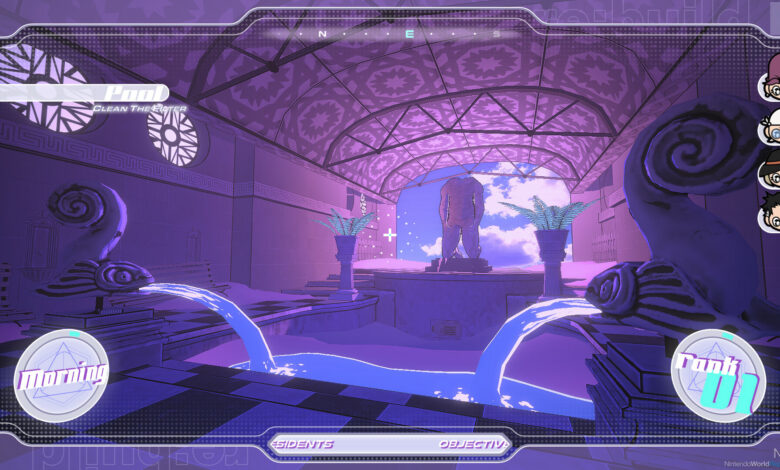
There’s something unsettling about the sinister nature of Roman Sands Re:Build. The game lures you in with a bright and shiny neon color palette and bombastic interface. Everything pops off the screen, while the soundtrack shifts between lo-fi and hyper pop at breakneck speeds. From the opening presentation, we are thrown into a world of absurdity without much explanation, but soon enough, ominous events start to occur around the fringes, hinting at something darker just underneath the surface.

That’s the opening to the new indie game published by Serenity Forge and developed by Arbitrary Metric. Now, if you haven’t heard of Arbitrary Metric, they are the legends behind Paratopic, a retro-styled horror adventure game that was voted as one of the best of 2018. Now with Roman Sands Re:Build, they have created a visual novel time loop game that uses dual interconnected narratives to constantly keep you guessing as to the nature of what’s really going on.
Roman Sands begins with players controlling a nameless protagonist who washes up on the shore of an island resort. Upon meeting the guests, it turns out that we work there and the guests have demands, so we better hop to itl. As you conversate and learn about the guests, you are presented with quests to find things like their favorite chair or their medication, which are located around the resort, but when you go into a new area with a loading screen, it takes a portion of your day, morning to afternoon to evening. Once we’ve completed what quests we can, the game instructs you to go back to the beach, and the level is recapped.

The end of the loop results in leveling up, and rewarding you with a variety of different upgrades such as a faster sprint, more time segments, and access to the customer shop. Then you begin the loop again, this time with a clear goal in mind. Over time the loops become easier; you start to become more efficient. Every loop is another chance to figure out how to min-max your exp. Eventually the resort opens up even more, giving players even more quests, times of the day, and puzzles to figure out in the most efficient way. This, to me, is when the game felt the best: interacting with each guest, learning their clockwork movement, and figuring out how best to knock out as many missions as possible, as quickly as possible.
All the while, there are hints at something else going on in the periphery. Tentacles appearing in places that shouldn’t be, magical painting portals being found, the ever-growing threat of the sun growing to destroy the planet–it’s all just slightly askew to what we would know as reality, minus the time loop, of course.

Eventually you unlock a second story, where you are one of the last people left alive at a research facility, with only a dead cow and a familiar voice over the radio. It’s here where the game goes into a surreal space, where you are tasked with removing a parasite from the internal systems. Doing so would mean preserving the facility’s research, but could also mean the end to your survival. Despite this area being mostly about puzzles within a much less vibrant atmosphere, having a friend on the radio helping you out was a welcome change of the game’s narrative structure, and leans heavier into the sci-fi horror with a pinch of gore. Still, it’s an overall toned down experience comparative to the first half of the game.
How do the two narratives meet and what do they have to do with one another? That’s the central mystery presented in Roman Sands Re:Build, and there really is so much to discover. There’s a mysterious gashapon mini game, and lots of lore details sprinkled in every nook and cranny. So much so, that it may take multiple playthroughs to catch everything that’s going on within the dual stories.
Roman Sands Re:Build is a narrative experience that has a sole purpose of telling a hyper specific story in a hyper specific way. There’s been a crop of these low-poly horror stories that use style and unique gameplay mechanics to enhance very unsettling tales that tend to stick with you. I still think about games like Mouthwashing, Threshold and Titan Chaser as games using similar attributes to what you see in Roman Sands. More of an experience in nature than your classical videogame, but they stick in my brain nonetheless. I’ve been waiting for this game since its announcement and now that it’s here, it’s something I’ll be thinking about for a long while. A little Danganropa, a little work sim, but a lot to ponder.