Big Walk (Nintendo Switch 2)
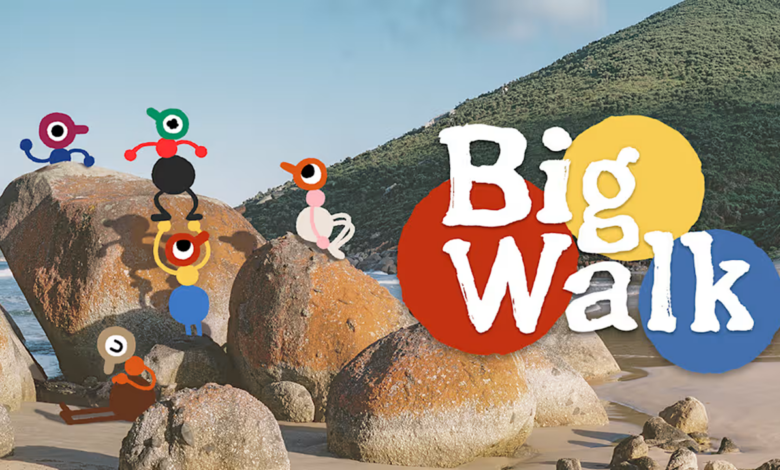
An intriguing-looking title, I still suspected Pure Nintendo would likely skip Big Walk because of its strictly online, co-op-only nature. Thankfully, the team received multiple press codes for coverage. And in fact, we’ve already discussed this game quite a bit on our podcast. Some of these observations will sound familiar to PN fans, but this review reflects a group consensus.
While our favorite multiplayer gaming experiences are with friends in the same room, we were open to an online adventure. Curiously, the Big Walk devs at House House almost seem to view the adventure as a secondary element, saying (among other things), “Adventuring aside… spending time with friends is the best part of a big walk.” Let’s agree to disagree. Had this game been released at the height of the pandemic, that claim would make far more sense. But in 2026, if we want to spend time with each other, there are far more practical ways to do so (even with hours separating us) than dealing with the limitations and restrictions found here. Rather than being pushed to the side, the adventuring was front and center with the PN team.

And the gameplay works! We’ve likened the adventure to a cooperative Myst-style escape room, except on a huge island. Big Walk necessitates lots of exploration, first to locate areas of interest with puzzles, and next to figure out how to complete them. We had some good chuckles as we attempted solutions that many could probably make look easy, but we made look hard. And puzzles adjusted whether we were playing as a pair or a trio. You can play the game with up to 12 players, but that’s so impractical I imagine few ever will. Still, we experienced good entertainment as a trio.
As we picked up the rewards for puzzle completions (gourd, squash-looking items that acted as keys), the initial satisfaction soon gave way to some annoyance. Even though we play as two-handed creatures, we can carry only one item at a time. Numerous helpful in-game tools are fun to experiment with, but we have a hard time wrapping our heads around the design choice to limit them. To what end? How is it beneficial? Does it add to the enjoyment? Hours in, we were still hoping for positive answers. It seems like a technique to make everyone feel involved, but it comes across less as satisfying teamwork and more as a hurdle. And time was at a premium for our busy team.

Since night comes quickly in the wilderness, and you can’t count on being able to hold a light source, you have to be creative. Ornament-shaped objects act as light sources, so we used them to mark trails and highlight puzzles we’d want to return to. You can even use a flare to light up the night sky. Credit to the game; it pulls off the lighting well. And while you may have to sit and wait for day on occasion (lest you get lost), it feels like an integral part of the gameplay, while executed in a visually fine way.
Hopefully any downtime is spent near scattered radios, so you can enjoy some quirky music. Night will pass more quickly if you can listen to tunes you might otherwise only hear in sparse bursts. The tracks successfully evoke several emotions and moods in tandem. I’m excited to see what these composers come up with next for future games.

As much as House House wants us to simply walk, sit (seats are everywhere), and talk, that would not be an effective use of our time, gameplay-wise. I already felt the pressure as host, trying to coordinate different time zones. Heck, we probably spent the first hour bemused, since the game largely leaves you to your own devices, save for a tutorial that could assuredly benefit from more attention to detail. This isn’t a game you’ll click with immediately, as there is a learning curve. Nor is it a game you’ll beat quickly. Perhaps other outlets received codes weeks ahead of us, but each time we returned to the game, it took a fair bit just to regain our sense of it and then return to where we left off. Big Walk would be an ideal game for younger online players with fewer life responsibilities.
And the reality is, talking is only practical if your characters are in close proximity. Otherwise, you’d better hope you find walkie-talkies, which frankly would’ve been a smart option out of the gate. Using gestures, while a fun idea, is about as effective as when I do pantomime with my wife—not very. We get the thinking, but the execution just leaves us wanting a bit more. Getting from point A to point B calls for enough focus already, without having to turn around every few steps to make sure nobody takes a misstep and gets snagged in the rocky terrain.

Even hours in, we couldn’t shake the feeling that perhaps we were missing something fundamental, but evidently not. Team House House seems to have hit all their development goals with Big Walk. It’s just that some (while well-intentioned) felt misguided. Still, the game is finding success (both commercially and critically), and we’re happy for that. Hopefully it can lead to an expanded, more user-friendly follow-up, with better balance and polish, making the entertainment more accessible and less the type you have to carve out time in your schedule to work for. The peaks are there for the finding!
If you have a group of agreeable friends with strong internet connections, plenty of time to spare, and a commitment to see the game through, Big Walk could be highly memorable. We’re hoping for a sequel with Gameshare support that’s a little more of an exploration puzzle-solving adventure, and a little less walking simulator. The former was our highlight, and once the “walker-talker” novelty wears off, they’re what will make the game endure as a showcase of its best.