Review: Mario Tennis Fever (Nintendo Switch 2)
Mario Tennis Fever is the latest in the long-running series. Each entry involves Mario and his pals from the Mushroom Kingdom taking to the court in action-packed matches. This outing is exclusive to the Nintendo Switch 2, making it Mario’s first sports title for Nintendo’s latest hybrid console. With that heavy burden on its shoulders, does Mario Tennis Fever manage to serve up a good time?
I was surprised to discover, as part of some background research for this review, that there are, in fact, ten Mario Tennis titles. The first was Mario’s Tennis, which launched for the ill-fated Virtual Boy in 1995. As a Virtual Boy launch title, we’re unsure why it didn’t debut with the Online Classics list of Virtual Boy games recently, but that’s a separate issue. It’s unclear whether launching so close to a brand-new Mario Tennis outing would have been a mistake or a stroke of genius. Either way, it didn’t happen.
Regardless, Mario has been slamming shots on the tennis court for over 30 years now, bringing a slightly zany approach to the sport à la Mario Kart. This style creates a divisive fanbase; some players want a more pure tennis experience while others enjoy the Mario-esque gimmicks. Mario Tennis Fever does its best to accommodate both types of gamers.
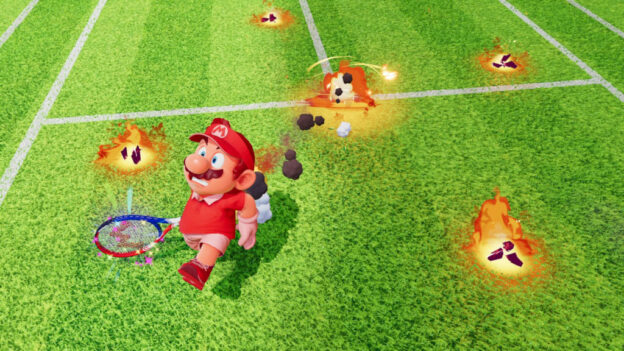
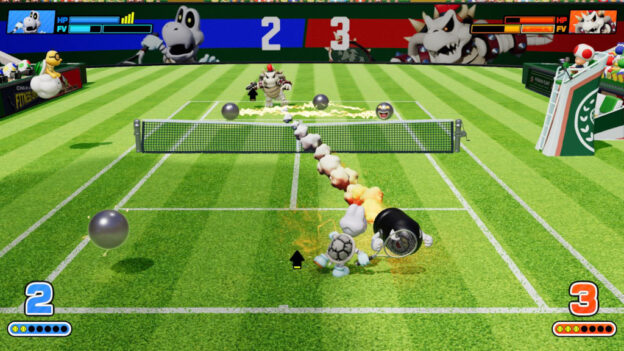
In the case of Mario Tennis Fever, it adds a new schtick in the form of Fever Rackets. There are 30 of these to discover, each with its own special power. Some add obstacles to the court temporarily, like the Banana Racket, Fire Bar Racket, and Mud Racket. Others are more helpful, such as the Star Racket, Swerve Racket, and Golden Dash Racket.
Using these rackets is extremely easy. As you play, a special Fever gauge fills up. Once it’s ready, you can use the X button to hit the ball and unleash your racket’s power. Importantly, this doesn’t slow the progress of the game, and feels like an enhancement to proceedings rather than a hindrance. Additionally, quick-thinking players can return the incoming ball from a Fever Shot, returning it before it touches the ground to give the offending team a taste of its own medicine. This adds an amount of balance to the game, evening things out so that even newbies can survive long enough to create long, tense matches.
Furthermore, you can switch off Fever Rackets entirely, providing that purer experience I alluded to earlier. This is the case in most modes, allowing players who don’t enjoy seeing tornados or Pokeys on the court to concentrate on skillfully returning the ball. Tennis, after all, is a little like a chess match; it takes tactics and persistence to win a game. On the flipside, if you love the fever rackets but can’t decide which to use, some modes allow you to choose two per game.
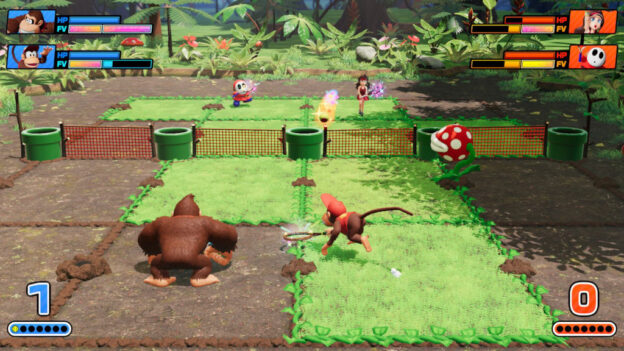
Mario Tennis Fever boasts a wide roster of characters. With 38 on offer, it’s the most ever in a Mario Tennis outing. Taking a cue from Mario Kart World’s expanded cast, this roster includes the unlikely tennis stars of Goomba, Chain Chomp, and Nabbit. Personally, I love seeing Goomba holding a tennis racket in his (its?) mouth. For me, this absurdity is part of the series’ charm. I also enjoyed the entertaining cutscenes that introduce each player before a match.
Characters fall into one of six categories: All-Around, Technical, Speedy, Tricky, Powerful, and Defensive. Trying every one to find who works for you is enjoyable, as is unlocking players. Fever does a good job of constantly providing new content, again like Mario Kart. After a certain number of matches, you’ll find yourself with a new racket, character, or court. It adds an extra incentive to proceedings.
Mario Tennis Fever is a Switch 2 title, and it shows. There’s no slowdown or load times. Graphically, everything looks splendid. While at first glance it appears not to push the boundary visually, everything on screen looks lush and detailed. Cut scenes and closeups particularly stand out, with some lovely detail on each character outfits.
There are a bunch of modes to choose from, providing plenty to do. For solo players, there’s an Adventure Mode and Tournament Tower. Adventure Mode is your typical story mode, following Baby Mario as he works through a series of events to restore adulthood to himself and his friends after they’re accidentally babified. Baby Mario’s initially weaker power means there’s plenty of training involved, but it serves a good introduction to the core functionality without feeling too much like a tutorial. Minigames and boss fights help mix things up, pitting Mario against various enemies on his journey. It took me about 5 hours to complete.
Tournament Mode can be tackled with one or two players. Here you’ll find yourself up against ten challenges, climbing a tower as you complete each one. You start with three hearts, allowing you to lose three matches before you’re out. When that happens, it’s back to the beginning! This provides a different way to enjoy the game, with challenges like scoring points via on-court hoops or avoiding return shots from your opponent. It gets tricky, too, making it a solid addition to the solo side of things.
Other modes include Free Play, Mix It Up, Swing Mode, Ranked Match, and Online Room. In short, there are plenty of ways to experience Mario Tennis Fever, with customizable matches that suit almost everyone. Importantly, the online modes are top notch, with no noticeable lag and no issues finding someone to compete with. My only niggle is that I’m clearly not as good against real-life players as I am against the CPU! My ranking suffered accordingly.
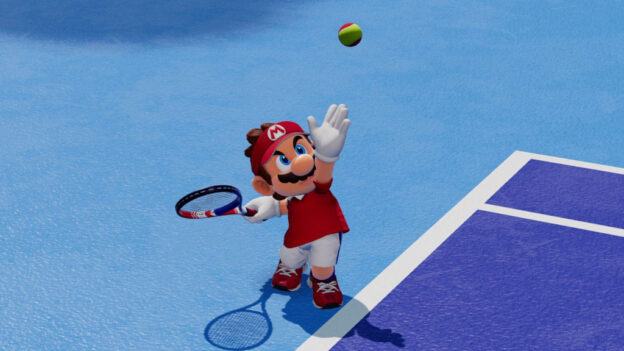
Whether you’re after a more pure tennis experience or something a little more crazy, Mario Tennis Fever has got you covered. This is one title my family and I will continue to enjoy for some time.