Tales of Arise – Beyond the Dawn Edition Review – Review

An RPG you can actually finish.
Confession time: I bought Tales of Arise shortly after it was released on Xbox. In all that time I only ever made it as far as the opening tutorial before getting distracted with review assignments or other releases. This Switch 2 release has finally been my excuse to actually put time into it, and has made me immediately regret waiting so long to play a game I’ve owned for years.
Tales of Arise is set on the planet of Dahna which has been conquered and enslaved by its neighboring planet, Rena. The story follows a mysterious young man initially known only as Iron Mask who finds himself working as a slave after losing all memory of his past life. Adding to this mystery is his inability to feel pain. When he is drawn into an encounter with a group of rebels and a Renan woman named Shionne, our hero is set on a quest to unseat the Renan lords who have taken control of the planet. In contrast to Iron Mask (he has a name but it feels like spoilers to say it) Shionne causes immediate harm to anyone who touches her. Their conveniently paired superpowers are played out in their personalities as well. Iron Mask is open and eager to help those in need. Shionne is closed off and lashes out at anyone who tries to get close. Their interpersonal writing is pretty hit or miss, they’ll seem pretty friendly with each other one moment and then be brutal enemies in the next scene. The overall story is quite good with some incredible character moments, especially for the additional party members who show up along the way. But individual character interactions for the leads are all over the place.

Gameplay in Tales of Arise is very linear. This is not some large open-world setting, or even a particularly wide hallway. Sidequests aren’t especially plentiful and generally do feel truly optional. I never found myself needing to grind and outside of the major boss fights, rarely found myself in real danger while playing on the standard difficulty. Tales of Arise seems much more interested in taking you on a narrative driven adventure than presenting you with a world to explore. This isn’t a bad thing, and it makes it pretty easy to do everything there is to do in each area if you’re a completionist. Customization is limited to a pretty expansive upgrade tree and a weapon and/or armor set for each region. This isn’t an especially deep RPG but I’m perfectly fine with that. As a result the story moves along at a very satisfying rate and you never spend too long in any one place.
The world itself is separated into small map segments, similar to something like the Ys series. Loading times between them are generally very short, but I did find that it made navigation somewhat difficult, especially in towns. Because the maps are always displayed individually rather than stitched together, I had a hard time getting a sense of where anything was in relation to anything else. It’s not too bad when you’re out in the field, as you generally have only one or two directions you can possibly go, but a few of the more labyrinthian environments can get frustrating.
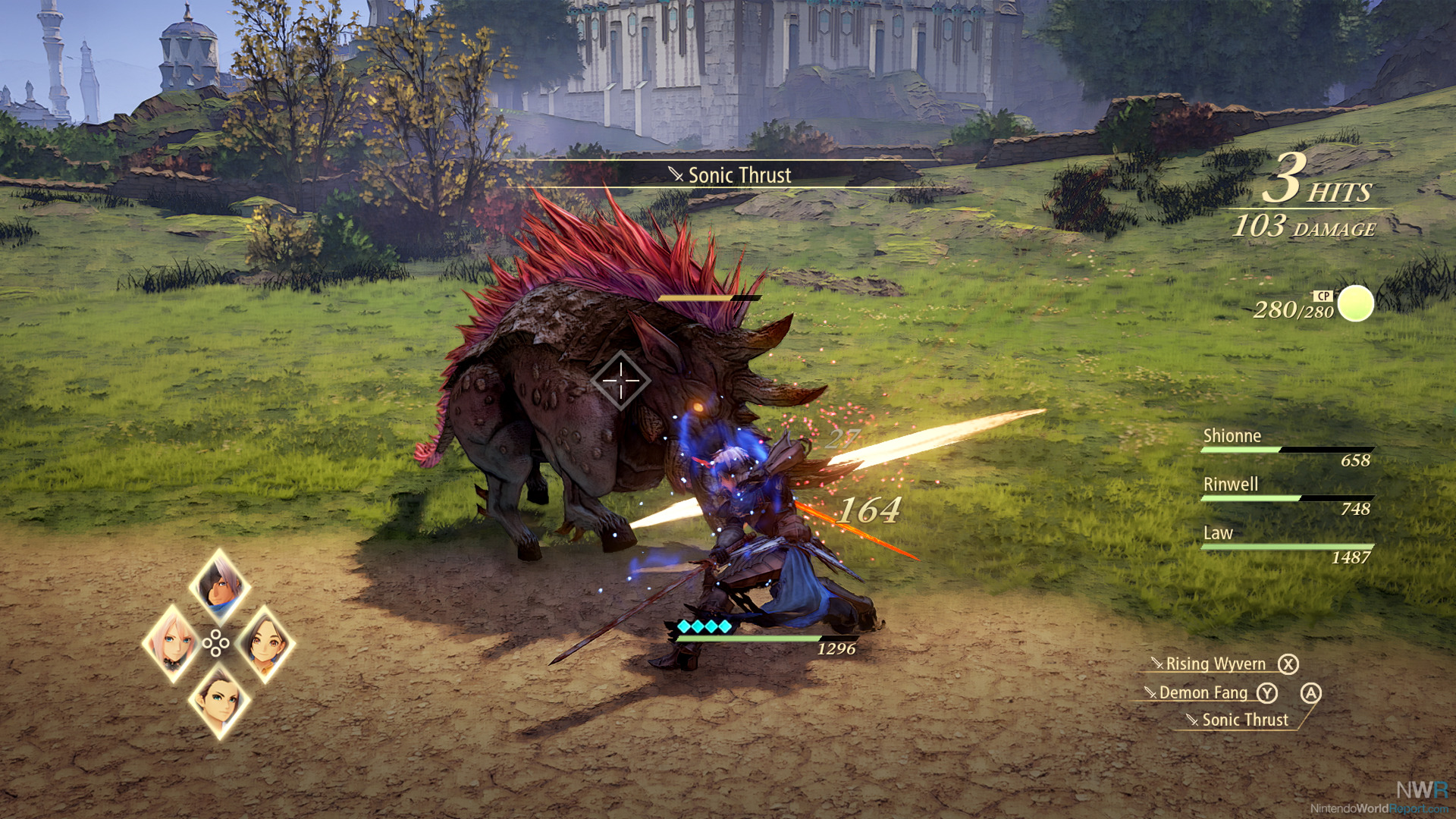
Like prior Tales games, combat is in real time, though you do transport upon encounters to a bespoke environment rather than fighting directly on the field. Combat starts very simple, with a focus on building combos between air and ground attacks. As you recruit additional party members, making use of each one’s abilities makes combat much more engaging. For example, one character can interrupt enemies attempting to cast magic. Another can break enemy shields. Watching for openings for other characters while directly managing your own can be a handful, but just gets more and more compelling the more abilities you unlock.
The Switch 2 delivers Tales of Arise competently if not flawlessly. Image quality looks good both docked and handheld. It helps that by design Tales of Arise has a stylized over sharpened presentation on all platforms. Some sort of edge based sharpening and contrast filter is applied to the game that gives the subtle impression of outlines. The end result is something that at times can look almost like an illustration or painting. Frame rate can however be an issue. It rarely gets below thirty but it fluctuates all over the place from being locked at thirty to being seemingly unlocked for random moments. A proper cap would do wonders for perceived fluidity. That being said, the overall presentation of Tales of Arise is excellent and a huge leap over previous entries. One of the advantages of having small segmented maps is that a lot of detail can be worked into each one, and the developers have clearly taken advantage of that. This is a very good looking game rich in stylistic flourishes.
Tales of Arise is a straight forward RPG that places narrative above mechanical depth or a grand world. There are times where that can be a little boring, as you’re railroaded from one story point to the next. At the same time that story is good enough that I was genuinely eager to see what would happen next. Combat is exciting and only improves as your options expand. The Switch 2 version has some issues in the frame rate department (though in fairness it wasn’t perfectly smooth on other platforms either). But the actual image quality and presentation remain as excellent as they were when this launched on other platforms. While it won’t be your next 100-hour epic, Tales of Arise provides an excellent, condensed, RPG experience both docked and on the go.