
How Random Reward Mechanics Make Modern Game Loops Feel Alive
Random rewards are often described as pure surprise, but that misses the real design trick. The strongest reward loops make players understand the possible outcome before it happens, then leave just enough uncertainty to make the next attempt feel fresh.
That is why random rewards sit between structure and suspense. A player may know a monster can drop rare gear, a roguelite room can offer 3 upgrades, or a reel-based game can trigger a feature, yet the exact result stays open. A 2024 journal article on perceived challenge and narrative immersion in RPGs is useful here because it shows how challenge shapes attention, emotion, and the feeling of being pulled deeper into play.
Where Random Rewards Become Easy To Read
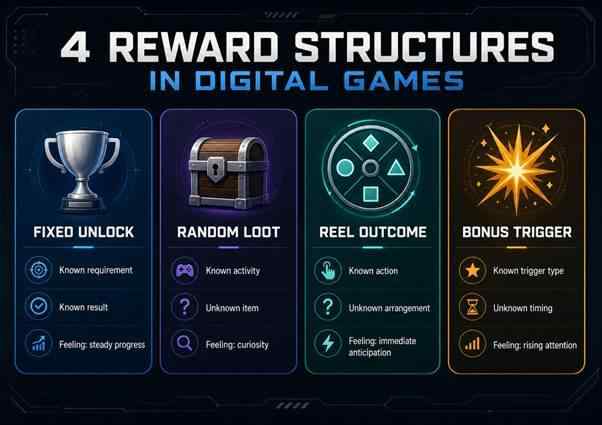
The easiest way to understand random reward mechanics in games is to compare them with formats where the outcome loop is clear from the start. Fixed rewards are predictable: finish a mission, collect a badge, raise a level, open a path. Variable rewards work differently because the player understands the action but not the exact result.
That structure appears in RPG loot drops, shuffled card draws, roguelite upgrade rooms, bonus wheels, and reel-based games. A dedicated pokies collection, such as Joe Fortune pokies, gives a clean example of this visible loop because the page brings together online pokie formats where reels, themes, feature triggers, Hold & Win titles, progressives, Ways Pays, video pokies, 3-reel games, and 5-reel games can be understood as variations on randomized outcome design.
The point is not that every format feels identical. It is that Joe Fortune pokies make the comparison easier because the player can notice how presentation changes rhythm: classic reels keep the loop direct, video pokies add more animation and theme, while feature-led formats build anticipation before the result resolves.
The quick comparison below is a compact way to see the same idea across game types. Each structure gives players a reason to repeat an action, but the emotional texture changes depending on how much is known before the result appears.
Fixed Progress Builds Trust First
A game cannot run on surprise alone. Players need stable rewards so they can understand the world and believe their effort is being recognized. Story chapters, level caps, crafting materials, trophies, XP bars, and skill trees give that sense of dependable movement.
That certainty is not boring. It is the foundation that allows uncertainty to work. If everything is random, the player loses the ability to form expectations. If everything is fixed, repetition can become too visible. Good reward design blends both. A player might know that completing a dungeon will move the story forward, while still being curious about which equipment, upgrade, or optional item appears.
This is why random rewards feel different from ordinary progress. They add tension to actions the player already understands. A monster encounter is no longer just a fight. A chest is no longer just a container. A new run is no longer just a reset. Each moment carries a small question.
Feedback Makes Uncertainty Feel Designed
Randomness needs strong feedback to feel intentional. The system may choose the result behind the scenes, but the player experiences timing, sound, animation, pacing, and recognition. A rare item drop feels different when the screen pauses. A new upgrade feels more meaningful when its effect is immediately readable. A bonus feature feels sharper when the buildup teaches the player what to watch for.
This is where presentation matters. Two games can use similar random logic and still create completely different feelings. A fantasy RPG may frame a drop as discovery. A roguelite may frame a new option as a tactical pivot. A card game may frame uncertainty as hand management. A reel-based format may frame it through motion, reveal, and symbol recognition.
The design question is not simply “is this random?” It is “can the player read what might happen and feel the result when it does?” When that answer is yes, randomness becomes part of the game’s language, rather than background math.
The Pattern Is Bigger Than Loot
Once players recognize the pattern, they might start to spot randomness in more genres than expected. Procedural maps, rotating challenges, enemy drops, shuffled decks, daily selections, bonus rooms, and upgrade rolls all use uncertainty to refresh familiar actions. The strongest examples keep the action legible while allowing the outcome to vary.
That is why random rewards remain powerful even in games with different audiences. They do not replace skill, progression, story, or atmosphere. They add a layer of possibility around them. A random reward loop can be satisfying because it gives a known action a new edge.
The useful takeaway is simple: random rewards are not only about what appears at the end. They are about how the game prepares the moment, how much the player understands before acting, and how the feedback lands afterward. This fits with a 2025 journal article on eight types of video game experience, which explores more about how players understand and interact with games.


