Jim Cornette Explains Why Rick Rude’s D-Generation X Run Isn’t as Simple as Fans Remember
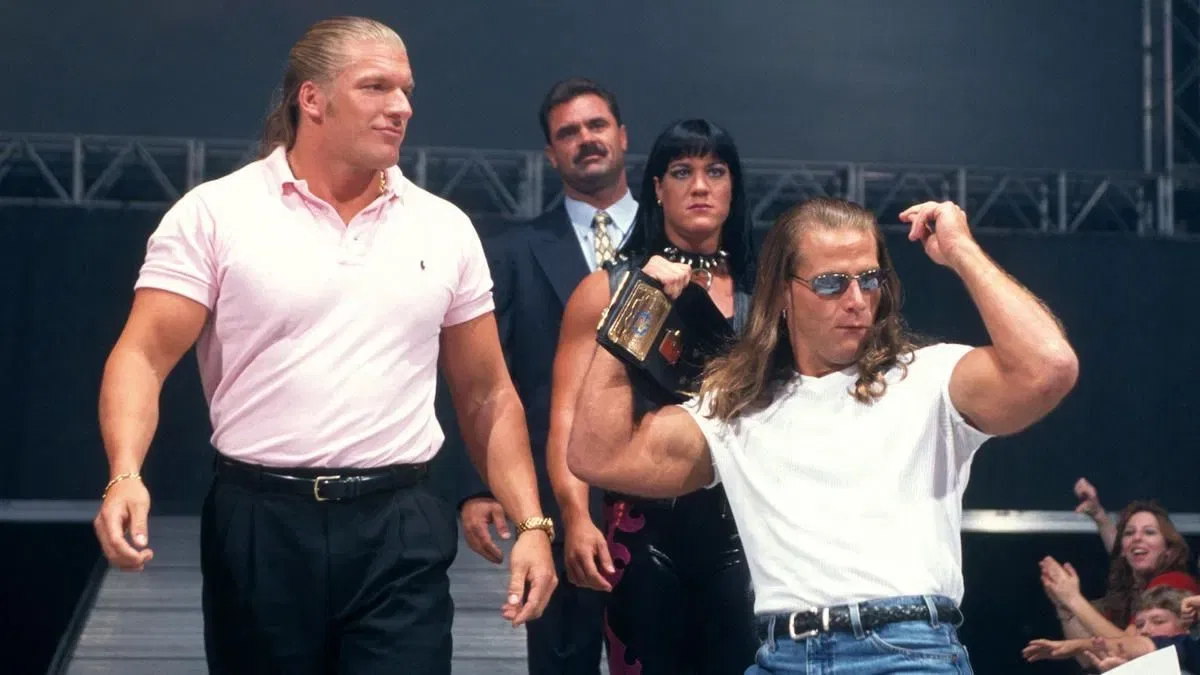
Rick Rude’s brief association with D-Generation X is often remembered as one of WWE’s strangest creative fits, a legendary throwback personality standing silently beside Shawn Michaels and Triple H at the height of their chaos. Fans have debated for years whether it was a misfire, a misuse, or simply bad timing. The reality, according to Jim Cornette, sits far outside the usual creative explanations.
The pairing wasn’t driven by character chemistry or locker room dynamics as much as it was shaped by circumstances Rude could not work around. Cornette, reflecting on that period, admitted the creative trail itself has faded with time. “I cannot remember the exact chain of events or the thought process,” he said. “Some of those memories are clouded by PTSD.”
What Cornette does remember clearly is that Rude’s physical situation had already closed the door on any meaningful in-ring run. After suffering a serious back injury, Rude cashed in a Lloyd’s of London insurance policy, a move that effectively ended his ability to wrestle. “Rude had one of those Lloyd’s of London policies, and when he got the back injury, he cashed it in,” Cornette explained. “That meant he really couldn’t work.”
That choice put Rude in the same category as several other wrestlers who carried similar coverage. Once the payout was taken, returning to singles competition was no longer an option. “Animal had one. Kurt Hennig had one. Flair was one of the few who had a policy and didn’t collect on it because he’d rather keep wrestling,” Cornette noted.
With Rude sidelined physically, WWE pivoted to using him as an on-screen presence alongside Michaels and Triple H. From a booking standpoint, Cornette felt that decision wasted what made Rude special. “Even if he wasn’t going to work, it felt like a complete waste of Rick Rude just standing there holding a briefcase,” he said.
That creative stagnation, combined with a short-term deal, ultimately pushed Rude to make one of the most infamous jumps of the era. “They didn’t sign him to a long-term contract,” Cornette recalled. “He made the jump without telling anybody and went to do the same thing in WCW for probably more money.” Rude’s same-day appearance on WCW television, complete with a shaved beard to expose Raw’s taping schedule, became a defining moment of the Monday Night Wars. “I don’t blame him,” Cornette added. “He obviously didn’t like what he was being given to do.”
Rude’s DX stint highlights a recurring tension in professional wrestling between legend value and physical reality. When a performer can no longer wrestle, creative often struggles to find a role that feels worthy of their legacy, especially during eras driven by momentum and attitude rather than nostalgia.
In that sense, Rude’s exit fits a broader pattern from the late 1990s, where stars with name recognition but limited in-ring futures were forced to choose between diminished roles or greener pastures. It is a reminder that some creative decisions are less about vision and more about the constraints no storyline can overcome.
If you use any quotes from this article, please credit Wrestling Headlines and the Jim Cornette Experience