Mechanics, Dynamics, Trust: Jackpot City Stress-Tested (Canada)
If you’re a Canadian player outside Ontario asking whether Jackpot City is legit, the short answer is yes. It is dual licensed in Canada, audited for fairness and has clear regulatory oversight. However, in this PlayStation Universe article, we won’t stop at surface-level claims. We’re taking a different approach to this review: one that speaks the same language gamers do.
We’ll stress-test one of Canada’s most visible iGaming brands using a common game design framework called MDA (Mechanics, Dynamics, Aesthetics). While it may sound technical, the logic is actually quite simple. And in this article, we’ve adapted it specifically for iGaming to get a more accurate verdict on Jackpot City’s legitimacy.
Quick Access: If readers are looking to verify any of the details covered in this article, here is the official Jackpot City platform for Canadians.
Jackpot City Casino Review: The Basics
Jackpot City casino has been around since the late 1990s, which in online gambling terms makes it a legacy platform rather than a new launch. It’s operated by Baytree Interactive, a named company with disclosed licensing and a long operational history. As a product that we’ve gotten our hands (and clicks) on, it was immediately clear why other reviewers report positive experiences. It’s not experimental; it behaves more like a mature live-service platform than a fly-by-night site.
It holds licenses from the Kahnawake Gaming Commission for the rest of Canada (outside Ontario) and from the AGCO for Ontario players specifically (note that Ontario is outside the scope of this article).
But longevity doesn’t equal legitimacy on its own. That’s why we’re stress-testing Jackpot City casino from a gamer’s point of view, focusing on security, payouts, game variety, and whether the overall experience feels reliable enough to trust with real money.
Why Use the MDA Framework (And Why We Modified It)
In professional game design, there’s a framework called MDA (Mechanics, Dynamics, Aesthetics) that lets us dissect how games work. It can be applied to any game, from The Last of Us to Gran Turismo. Let’s break down its variables. Mechanics are the rules and systems. Dynamics are how those systems create player behavior and loops. Aesthetics are the emotional responses—the feeling you get when everything clicks.
For example, you could say Mario Kart has tight mechanics (drift and item timing), competitive dynamics (the constant battle for first place), and visceral aesthetics (the chaos of a blue shell stealing victory at the line).
But when you’re dealing with a real-money platform like Jackpot City casino, “Aesthetics” doesn’t cut it. That’s why we modded the third factor. When money is on the line, we don’t really care if the slot machines have flashy Vegas visuals. What matters is whether the platform deserves your Trust. That’s why we’ve adapted the framework into MDT = Mechanics, Dynamics, Trust.
As such, this isn’t a typical casino review. It’s an audit using the same critical lens we’d apply to any live-service platform. We’re looking at the engine under the hood. This means studying the player loops that keep you engaged, and whether the whole system is designed to be fair—or just for house edge.
What You Can Expect from This Audit
- Mechanics: We’re looking at the rulebook. How does Jackpot City actually work? What’s the backend engine? What are the wagering curves and withdrawal processing flows like?
- Dynamics: We’re looking at the player loop. How does the platform encourage behaviour? How’s the “grind” like? Where do issues hit, and does the system respect your time?
- Trust: We’re doing an integrity check. Is this platform licensed and regulated? Does it pay out? Are the games independently tested and does the operator have a track record you can verify?
1. Trust: The Legitimacy Check
Who’s in charge and is it all legit?
First off, let’s look at who actually runs the show here. Jackpot City casino Canada is run by Baytree Interactive Ltd – a known and established operator with a good history. For Ontario players specifically, it’s run by Cadtree Limited (License: OPIG1236392). You can find Jackpot City on the official iGo page.
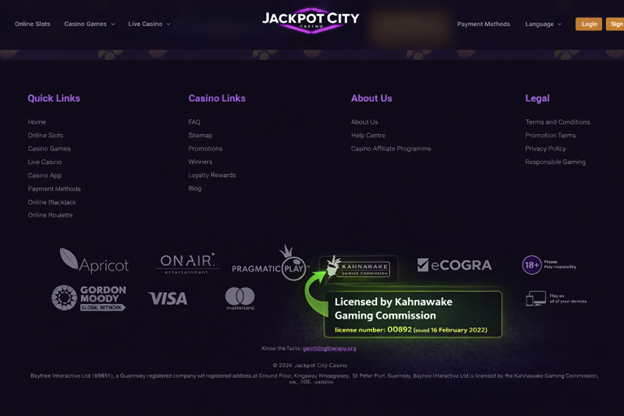
Jackpot City accepts non-Ontario Canadian players under an offshore licensing model. That’s right – it’s licensed by the Kahnawake Gaming Commission, license number: 00892 (issued 16 February 2022). You can verify the operator status on the KGC permit holders list.
Different Licenses : Different Levels of Trust
In the iGaming world, regulatory bodies vary wildly in how strictly they enforce player protection, dispute resolution, and financial oversight. To properly audit Jackpot City’s Trust score, we need to understand where its licenses sit in the hierarchy.
Tier 1: High-Standard Regulatory Bodies
These are the gold standard. Operators under these jurisdictions face strict KYC/AML enforcement, mandatory responsible gambling tools, and real consequences for non-compliance (including license suspension or revocation).
- United Kingdom Gambling Commission (UKGC)
- Malta Gaming Authority (MGA)
- Gibraltar Licensing Authority (GLA)
- Isle of Man Gambling Supervision Commission (GSC)
- Canada’s Provincial Regulators: AGCO/iGO (Ontario), AGLC (Alberta), BCLC (British Columbia), Loto-Québec, MLGCA (Manitoba)
- Ontario’s two-tier model (AGCO registration + iGO operating agreement) represents the strictest oversight for casinos in Canada.
Tier 2: Standard Regulatory Bodies
These jurisdictions are legitimate but enforce lighter oversight. An operator’s reputation and operational history can sometimes matter more than the license itself.
- Kahnawake Gaming Commission (KGC) — Long-established with a solid track record, but player dispute resolution can be inconsistent. This is where Jackpot City holds its Rest-of-Canada license.
- Curaçao Gaming Authority (CGA) — Undergoing major reform in 2025; sublicenses are being phased out and AML enforcement is tightening.
- Anjouan Gaming Commission — Newer but enforces KYC/AML through audits despite misconceptions about lax standards.
Tier 3: Low-Standard Bodies
Avoid unless the operator has an extensive, verified reputation elsewhere. These jurisdictions provide minimal (or zero) enforcement.
- Belize Gaming Control Board (BGCB)
- Costa Rica (no actual gaming division; just “data processing” licenses)
- Panama Gaming Control Board (PGCB)
Where Jackpot City Sits:
Jackpot City holds a Tier 2 (KGC) license for the Rest of Canada and a Tier 1 (AGCO/iGO) license for Ontario players. Notably, the brand also maintains active Tier 1 Malta Gaming Authority (MGA) and UK Gambling Commission (UKGC) licenses for its European and British operations. While these don’t offer direct legal recourse for Canadians, they serve as a reputational signal. A platform capable of passing the world’s strictest audits is less likely to cut corners elsewhere.
But beyond licenses, we need to dig deeper into the platform’s operational behavior—which is exactly what the security and fairness sections will cover.
Security and Fairness
The trust case for Jackpot City rests on a combination of longevity, oversight, and technical safeguards. As common in the industry, it uses standard SSL (Secure Sockets Layer) encryption to protect your account logins and payments. This is the same fundamental tech used by the PlayStation Network (PSN) to secure your PS Plus data and digital purchases.
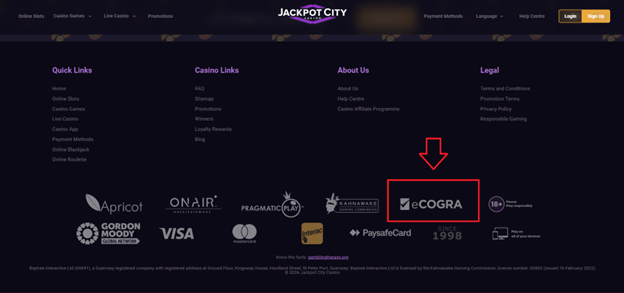
When it comes to game fairness, the platform relies on independent audits of its Random Number Generators (RNG). Jackpot City is certified by eCOGRA (eCommerce Online Gaming Regulation and Assurance), a globally recognized test lab that serves as the industry’s ultimate referee. As per the screenshot below.
To put this in a video game context, think of eCOGRA as a specialized server-side anti-cheat. While standard software like Ricochet or Easy Anti-Cheat (EAC) looks for player-side manipulation, eCOGRA audits the “game engine” itself. They monitor the backend to ensure the mechanics haven’t been “nerfed” and that every spin or hand remains statistically unbiased over millions of rounds.
The Tiered Audit Framework
Just as with licensing, we classify testing labs into tiers. These “technical referees” are responsible for auditing the RNG (Random Number Generator) to ensure the game isn’t rigged against you.
Tier 1: Global Industry Leaders (The “Gold Standard”)
These labs are the most prestigious and are trusted by the world’s strictest regulators (like the UKGC and AGCO). They don’t just check if a game is random; they perform deeper source-code reviews to ensure system integrity.
- eCOGRA: The heavy hitter for player protection. As seen in the Jackpot City footer, they provide a “Safe and Fair” seal that covers both technical fairness and responsible gambling.
- GLI (Gaming Laboratories International): The largest independent gaming test lab in the world, maintaining 20+ global labs and a massive 2.5 million device testing milestone.
- iTech Labs: Highly respected for their extreme technical rigor and statistical simulations.
Tier 2: Standard Compliance Labs
Highly respected labs that focus primarily on technical certification rather than broad “player-facing” trust seals.
- BMM Testlabs: The original independent test lab (founded in 1981), making it the longest-established private lab in the industry.
- NMi (Gaming): A respected European body that handles technical standards across multiple high-security industries, including gambling.
Tier 3: Niche or Regional Labs
Legitimate but often specialized in a single jurisdiction or newer to the global stage.
- Gaming Associates (GA): Often used as a secondary auditor for specific European markets or niche technical compliance.
Where Jackpot City Sits
Jackpot City uses eCOGRA (Tier 1), which is the best-case scenario for a player. While some sites might use a Tier 2 lab just to meet legal minimums, an eCOGRA seal means the platform is inviting an extra layer of “player-centric” scrutiny that covers both the math and the operator’s behavior.
RTP Transparency and Payout Reports
One of the strongest signals of a “Tier 1” trust level is the public disclosure of payout percentages. Unlike “black box” casinos that hide their math, Jackpot City provides regular payout reports that are audited and verified by eCOGRA.
You can typically find a dedicated Payout Percentages or Game Return link in their website footer or within their Help Centre. These documents are updated regularly and list the audited RTP for every game category—from slots to table games to live dealer.
RTP Performance Tiers
Like with licenses, not all casino RTPs are created equal. Here’s how to evaluate whether a platform’s payout rates are competitive, standard, or suspiciously low.
Tier 1: Excellent (97%+ overall RTP)
These casinos offer some of the best mathematical odds in the industry, often due to a mix of high-RTP table games, video poker, and carefully curated slot selections.
Examples of game types: European Roulette (97.3%), Blackjack variants (98-99.5%), high-RTP slots like Blood Suckers (98%).
Tier 2: Above Average (96-97% overall RTP)
This is where most reputable, player-friendly casinos sit. The platform balances profitable slots with fair table game odds.
Examples: Most NetEnt and Pragmatic Play slot libraries fall into this range.
Tier 3: Industry Standard (94-96% overall RTP)
Common among newer or budget-focused casinos. Not necessarily unfair, but the house edge is noticeably higher.
Tier 4: Below Standard (<94% overall RTP)
Avoid unless there’s a compelling reason (exclusive games, massive bonuses). These platforms prioritize profit margins over player value.
Where Jackpot City Sits:
Based on third-party audits and publicly available payout reports, Jackpot City consistently operates in the Tier 1-2 range (above 96% overall RTP), placing it among the more player-friendly platforms in Canada. The exact figure fluctuates monthly based on game mix and player activity, but the platform’s eCOGRA certification and transparent reporting ensure the math stays competitive.
For a more business-centric breakdown of the platform’s reliability, we recommend this SWOT analysis by fintech analyst Taylor Park. It provides a deeper look into the operational strengths and regulatory risks that underpin Jackpot City’s reputation.
2. The Mechanics of Jackpot City
Does Jackpot City actually pay out, and in real money?
Yes it does. Jackpot City is a real-money casino where Canadian players can deposit and withdraw in Canadian dollars. But here’s the important bit: winnings are only paid out once you’ve completed standard verification and any terms that might apply have been sorted out. Players who are used to instant digital rewards might be surprised at how the payout process works in practice.
But it’s better to take a bird’s-eye view than just take our word for it. From hearing what long-time players have to say, and looking at reviews from big, neutral casino review websites like Casino.org, CasinoGuru, and Trustpilot, it’s apparent that Jackpot City has a consistent record of paying out winnings to players who follow the rules.
These big review sites don’t think of Jackpot City as a problem operator, and instances of non-payment usually turn out to be linked to unresolved verification or bonus issues, rather than a decision to withhold payment. Of course, your mileage may vary, and we didn’t spot-check every unresolved issue or complaint. What we can do is share the general sentiment, and we’ll repeat that the operator is bound by its licensing requirements to disburse funds to players.
That’s a key distinction to make. Sites that don’t pay out often get nailed in the press, while Jackpot City’s profile suggests they are a platform that enforces the rules, but isn’t going to arbitrarily block withdrawals.
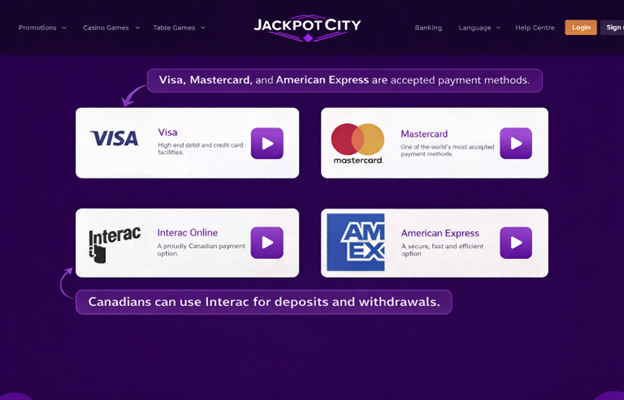
The Jackpot city mechanics stand out in two ways. For one, they are one of the few amex casinos in canada, and for two, we’ve found that Jackpot City has a solid VIP program with features such as point redemption and birthday gifts.
Cashing out at Jackpot City follows a pretty predictable sequence. When you know the following sequence, there should be very few surprises.
- Before your first withdrawal, you’ll need to do some identity verification : this usually means sending in some ID and proof of address. It’s a one-time step, but it’s the main reason why first withdrawals take longer than later ones.
- Once you’ve been verified, you choose a withdrawal method from the options available. Canadian players can usually opt for something like Interac, digital wallets, or card-based methods, depending on how their account was funded.
- At this point, the withdrawal goes into a “process pending” stage, while the casino checks your verification status, bonus conditions and account for fraud. Think of this as a bit of server-side validation before it gets handed over to the payment system.
- Once it’s been approved internally, the withdrawal is then handed over to the payment network, and that’s where things can get a bit variable – but it’s still pretty much standard industry stuff.
How fast are payouts, irl?
Jackpot City doesn’t promise instant withdrawals, and in practice they tend to match industry norms. Faster digital and wallet-based methods are usually processed within a day once a withdrawal has been approved, while card and bank-style withdrawals can take a few business days to clear. These are typical time ranges, not guarantees though, and first withdrawals are usually slower because you have to do that initial verification step.
Where players tend to run into trouble
Most payout frustrations come from the same predictable issues that pop up across the industry. Players try to withdraw before they’ve finished verification, or forget that they still have some bonus wagering to do, or select a withdrawal method that isn’t supported for their account. None of these are unique to Jackpot City, but knowing about them upfront can make all the difference in how smoothly things go.
A major “invisible” hurdle for Canadians is bank-side transaction blocking. While it is legal to play at Jackpot City, several of the “Big Five” Canadian banks have internal policies that automatically reject gambling-related transactions, especially for offshore-licensed sites.
- The “Unfriendly” Banks: TD Canada Trust and Royal Bank of Canada (RBC) are notoriously strict, often blocking both credit and debit card deposits to international sites. Scotiabank also has a high rejection rate for anything outside provincial lotteries.
- The “Gambling-Friendly” Banks: Bank of Montreal (BMO) and CIBC tend to have much higher success rates for iGaming transactions. Digital-first options like Koho can sometimes face rejections due to their underlying risk-management software, which treats gambling as a “high-risk” cash-like transaction.
To avoid these headaches, we recommend using Interac e-Transfer instead of direct card payments. It’s worth noting that Jackpot City is one of the few casinos accepting Loonio which serves as the leading Interac gateway for iGaming in 2026. This bypasses the bank’s automated card filters and ensures your funds move directly through your chequing account, which is almost always supported for both deposits and withdrawals at Jackpot City.
3. Dynamics : The Game Loop
The game library and overall experience
Jackpot City’s game library is pretty broad, but not really experimental. Slots make up most of the list, supported by a solid selection of table games and live dealer options. The platform is more about showcasing established titles that people know and trust, rather than trying to push the boundaries with untested ideas.
That’s all tied into Microgaming’s ecosystem, which has recently been rebranded under the Games Global umbrella. For gamers, the closest comparison is a big publisher with a deep back catalogue of successful releases, rather than some new-fangled storefront full of unvetted indie titles. Microgaming, in this context, is rather like the “Unreal engine” of the gaming world.
Usability follows the same philosophy. The interface prioritises clarity over flashiness, so you can find what you want without too much fuss : sensible categories, working filters and a search function that actually works are all part of the package. Finding a specific game should feel like browsing a familiar digital library, rather than trying to find a needle in a haystack.
Jackpot City runs right in the browser on both desktop and mobile, with mobile-friendly options for players who prefer a more app-like experience. Performance is solid, pages load quickly, and sessions don’t feel heavy or lag-prone.
Deposit Bonuses, wagering and managing your risk
Jackpot City’s $1,600 welcome deal for Canadian players (Rest of Canada only, ON excluded) is built around a multi-stage structure that rewards longevity rather than a single upfront burst. For gamers, think of this like a Battle Pass progression system: you don’t get all the loot on Day 1; the value is parceled out to encourage regular play sessions.
As of January 2026, the standard Canadian welcome offer (ROC only, ON excluded) includes:
- 100% match on each of your first 4 deposits (capped at $400 per deposit).
- 10 daily spins on the Mega Millionaire Wheel (one per day for 10 days) for a chance at a $1M jackpot.
- A manageable 35x wagering requirement before bonus funds convert to cash.
While the headline numbers are impressive, the real mechanic here is the seven-day claim window—you must opt-in and start the progression within a week of registering, or the offer expires.
Jackpot City Casino Online Wagering requirements
These can be viewed as the game’s “difficulty level”.
Bonus cash at Jackpot City comes with wagering requirements, which tell you how much you’ve got to play through before you can actually withdraw any winnings that come from using the bonus. Think of wagering as the “difficulty setting” attached to the bonus. On Jackpot City, it’s set at 35x.
In most cases, wagering falls within a pretty standard industry range – it’s usually a multiple of the bonus amount, or sometimes a bit more if you’re counting the deposit too. Slots usually count fully or almost fully towards meeting the wagering requirements, while table games are much less useful and might not count at all in some cases.
So, in practical terms, bigger bonuses can open up more possibilities, but they can also mean more work for you before you can get your hands on the winnings. Playing slots for longer sessions can clear the wagering faster than playing table games.
Treat bonus cash like in-game currency, not real money
For gamers, the easiest way to think about it is to treat bonus cash like in-game currency that comes with its own set of rules. It can make your playtime go longer, change the way the game plays out, and maybe even let you play at a higher level than you normally would – but at the end of the day, it’s not the same thing as actual withdrawable cash.
If you already plan on playing slots for long sessions and are okay with keeping track of your progress, then the bonus can add some extra value to your play. On the other hand, if you like fast games with minimal hassle and quick withdrawals, then you might be better off just declining the bonus and keeping things simple.
Taking care of yourself (and your bankroll)
Jackpot City has all the standard tools in place to help you keep yourself in check, but the most important thing remains your own bankroll management. Bonus cash doesn’t change the underlying risks of playing with real money, and you should never treat it as a way to recoup losses.
As a Canadian player, you’ll need to meet the local age requirements, which is 19 in most provinces. What matters most is that you’re playing within your means, and not getting caught up in chasing after every promotion that comes along.
Where Jackpot City Can Frustrate Gamers : Customer support, etc.
Even top rated platforms can have their downsides. One of the most common problems is the initial withdrawal process, which can feel pretty annoying if you’re used to getting your money in an instant elsewhere. Bonus wagering can also be a real drag if you don’t factor in the commitment upfront.
Customer support is alright, but sometimes it’s a bit of a pain to find. Then you get to talk to an agent (after navigating that fancy AI thing) and they usually do a pretty decent job, but you do have to dig around a bit to get hold of a real person.
These aren’t issues that are unique to Jackpot City, mind you. Real-money casinos all have their quirks – it’s just worth knowing about them before you get started.
Closing Thoughts
Players at Jackpot City have a lot of choices. They can enjoy a variety of games, including popular online slots, blackjack, and roulette, all powered by reputable providers like Pragmatic Play and Microgaming. The gaming platform is pretty straightforward, and the payments team ensures that payouts are reliable, with added value through the VIP program. While some users mention waiting for their withdrawal longer than they would like, the overall experience is undeniably positive. With features like free spins, bonus wheel, and progressive jackpots, it keeps the excitement alive.
Some find the wagering requirements and bonus percentages a bit frustrating; however, the sheer diversity of games makes up for it, in our mind. The mix of classic table games, video poker like Aces video poker, and unique titles such as Amazing Link Zeus ensures there is something for every type of player.
Final Verdict
For Canadian players outside Ontario, Jackpot City is a legitimate, long-standing online casino that behaves predictably and pays real winnings when its rules are followed. It offers a large and familiar game library, supports Canadian-friendly payment methods, and operates under an identifiable operator with established oversight.
The experience is not flashy, and it does not try to reinvent the genre, but it is stable, functional, and consistent. Bonuses can add value if you understand the trade-offs, and withdrawals require patience, especially the first time.
If you are looking for a reliable real-money casino rather than a novelty platform, Jackpot City does what it claims to do.
Responsible Gaming & Disclaimer
Players must meet the minimum legal age requirement—18+ or 19+ depending on your province/territory (Ontario is 19+).
If you or someone close to you is struggling with gambling-related issues, confidential resources are available through:
This content is published for informational and educational purposes only and is directed toward a Rest of Canada audience (Ontario excluded). U.S.-based players are not eligible to sign up.