This neat Windows registry trick boosts NVMe SSD performance up to 80% but it’s only officially available for enterprise users
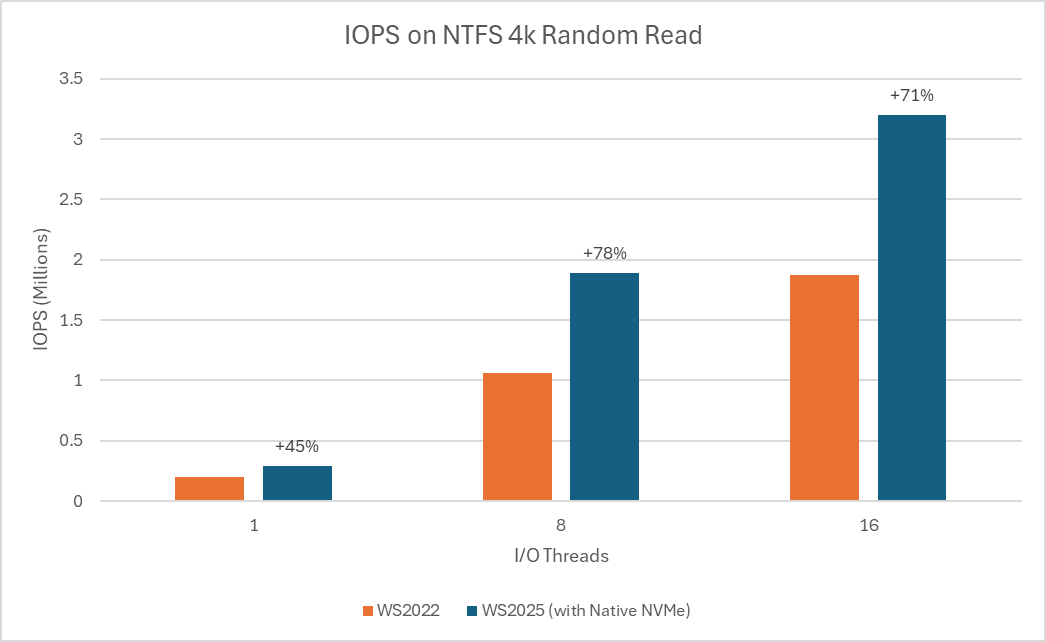
Users have discovered a registry tweak that can improve NVMe SSD performance on Windows 11, namely those all-important random 4k speeds.
Windows treats most drives as SCSI (Small Computer System Interface), which has been used for decades now and largely intended for hard drives. As such, NVMe drives that offer higher parallel performance than a hard drive are somewhat limited by the SCSI conversion: taking NVMe commands from an NVMe SSD and changing them to SCSI for the benefit of the OS, which introduces processing overhead and latency.
“With Native NVMe in Windows Server 2025, the storage stack is purpose-built for modern hardware—eliminating translation layers and legacy constraints.”
Native NVMe support is an opt-in model, so enterprise users need to enable it via the registry. What some users have found out, however, is that it’s possible to apply the same tweaks to Windows 11 and see similar improvements to those touted by Microsoft for enterprise users.
This is made possible through registry tweaks, which can only be carried out at your own risk. You can brick your PC, seriously.
As noted by Heise, the new driver is included with recent updates to Windows Server 2025 and Windows 11. There are three registry values that need to be set in order to get it operational, which, again, I really wouldn’t recommend doing on your own machine right now.
- reg add HKEY_LOCAL_MACHINE\SYSTEM\CurrentControlSet\Policies\Microsoft\FeatureManagement\Overrides /v 735209102 /t REG_DWORD /d 1 /f
- reg add HKEY_LOCAL_MACHINE\SYSTEM\CurrentControlSet\Policies\Microsoft\FeatureManagement\Overrides /v 1853569164 /t REG_DWORD /d 1 /f
- reg add HKEY_LOCAL_MACHINE\SYSTEM\CurrentControlSet\Policies\Microsoft\FeatureManagement\Overrides /v 156965516 /t REG_DWORD /d 1 /f
As noted in the above story, once enabled, an NVMe drive will show up under ‘Storage Media’ rather than ‘Drives’ in Device Manager. It also may cause some third-party software to incorrectly log the drive twice, not see it at all as some users report with Samsung Magician, or with some strange partition duplication, as noted by Tom’s Hardware.
Though early results are very promising. User Jonathanwashere1 found a large increase in random 4K read and write performance as a result of the tweak; 45% and 49% respectively. This metric matters most for OS and gaming and is the metric where we’ve seen only smaller improvement in speeds with new products over the past few years.
Heise reports access times were reduced in synthetic benchmarks from the tweak. Users on the Guru3D forums also suggest decent improvements to random 4K performance, as did Reddit users testing handheld performance.
Microsoft also notes that enterprise users can see up to 80% higher IOPS (the best metric for random perf) and a reduction of around 45% for CPU cycles—essentially freeing up the CPU by removing the unnecessary translation layer. Users in the comments of Microsoft’s post suggest mixed results but general improvements.
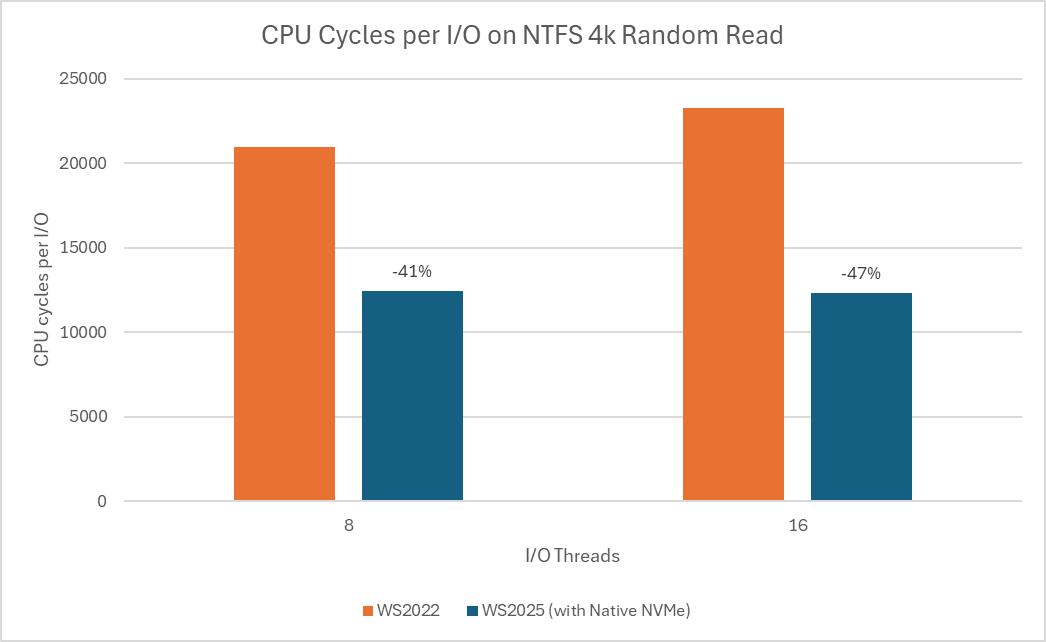
Altogether, a promising sign of things to come. should the update roll out to more systems. In order to do that, Microsoft will have to ensure it doesn’t break multitude of system configurations. How likely this is to rollout to the wider masses then, depends on how viable that is. Though it does sound like something that should be done. The current implementation is, as this shows, a needless bottleneck for performance.
As for any effect on game load times, our pick for the best PCIe 5.0 SSD, the WD Black SN8100, offers the highest random 4K speeds around and loads FFXIV around one second faster than other comparable drives. I suspect we’ll see some drives make larger gains with native NVMe support than others. Lower CPU overheads could make more of a tangible difference to performance on some PCs as a result.
As many users are keen to point out across the board, Linux has native NVMe support and has done for a very long time. So, if you’re willing to give it a go, this is all the more reason to try out Linux this coming year.
Best SSD for gaming 2025