Review: Space Adventure Cobra – Awakening (Nintendo Switch)
I love that gamers in 2025 get an adaptation of a relatively obscure (to this dilettante, anyway) 1982 anime. I love that it actually incorporates cutscenes from that anime. I don’t love the game itself, but I like quite a bit of it, so let’s tune in to Space Adventure Cobra – Awakening.
Space Adventure Cobra began life as Cobra, a manga series by Buichi Terasawa originally serialized in Weekly Shonen Jump in 1978. The timeframe is important, because Awakening very much has the slick style of that era. The story, dialogue, visuals, and music all have the funky, highly stylized vibe that you could only find on the cooler UHF channels back in the day.
The story follows Cobra, a space pirate in so much trouble with the Space Pirate Guild that he alters his appearance and erases his memory to escape them. How does that work, you ask? Well, it doesn’t. Cobra eventually gets his memory back, settles into his old ways, and, of course, is discovered and once again pursued by the Guild. It’s a space adventure, after all, so what more do you need?
Well, you need a curvy android named Lady Armaroid, you need gadget-laden cigars, and you need a left arm that can transform into the Psychogun. Cool enough for you? All of this follows the original 12 episodes of the anime series, we’re told. I haven’t seen them (an issue I would’ve already corrected if I subscribed to Philo), so I’ll take their word.
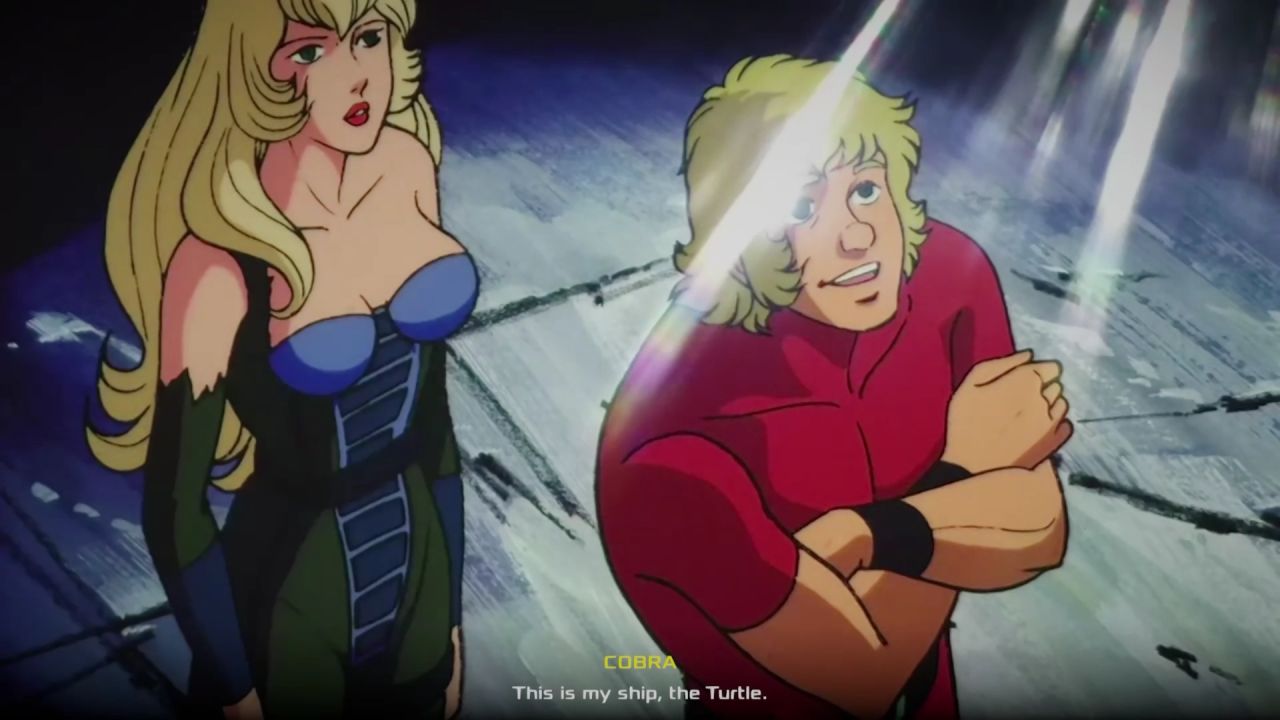
What this typically gives us throughout the game is an anime cutscene setup, 2D action-platforming gameplay based on that setup, then an anime cutscene wrapup. It’s a very effective approach, causing you to feel you’re part of the anime despite the disconnect between the anime and gameplay visuals.
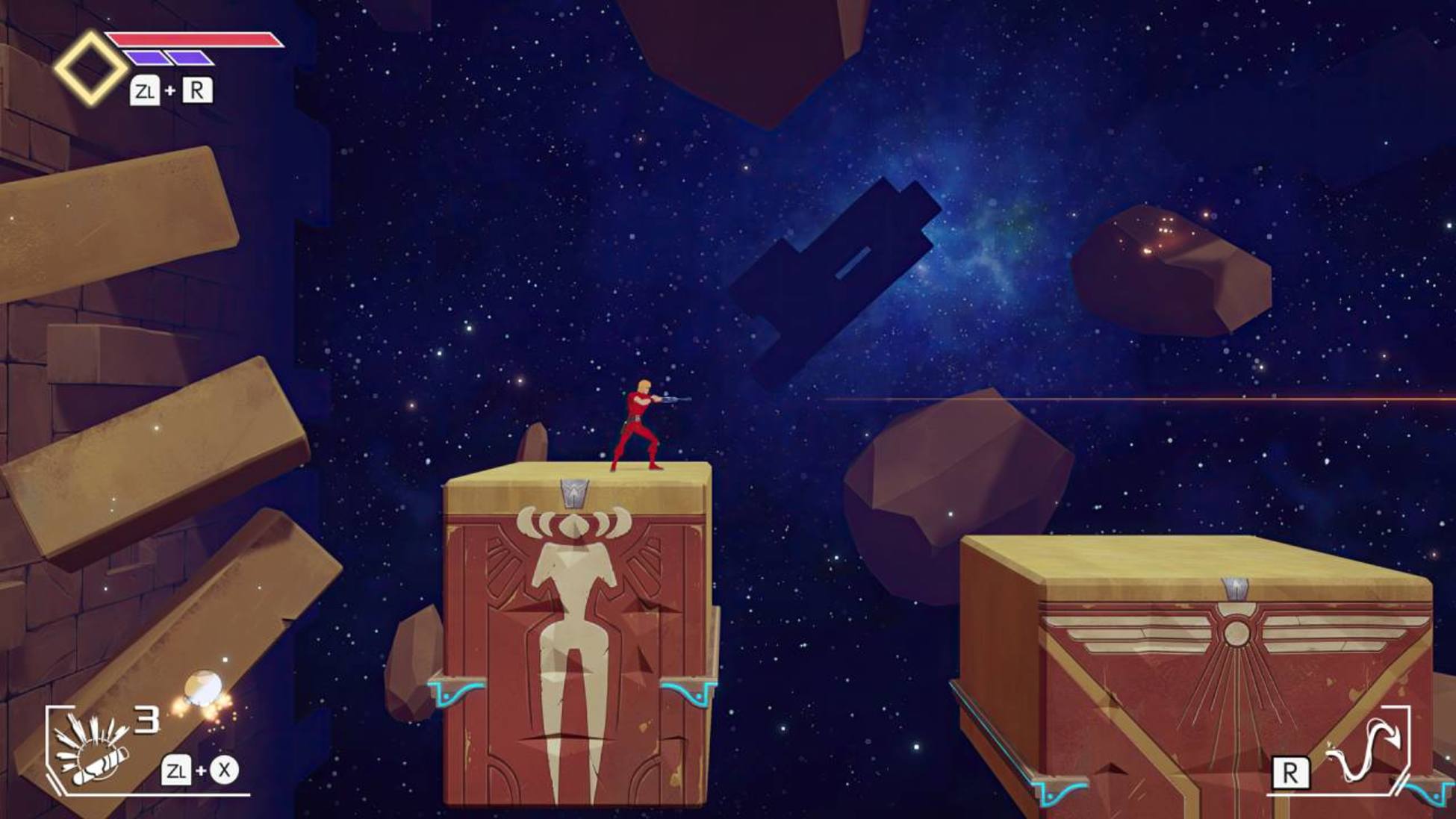
The gameplay itself is where I was let down a little, although that won’t be the same with everyone. Space Adventure Cobra – Awakening plays out as a linear action-platformer. Our hero immediately finds himself running, leaping, shooting, dodging, swimming, and grappling his way through enemy-infested areas, and this is before he gets his cooler weapons and powers. There are a lot of Joy-Con buttons to learn here. It’s manageable, but expect to spend plenty of time dying and respawning before you’re able to work your way through.
There are three difficulty levels to ease you in, but they don’t make everything easier. Why? Because of the platforming elements. Cobra will quickly have to learn how to grapple onto items in order to avoid, say, lava pits, and that’s not easy to do. Fall in and you die regardless of difficulty. Thankfully, the respawn points aren’t too far back.
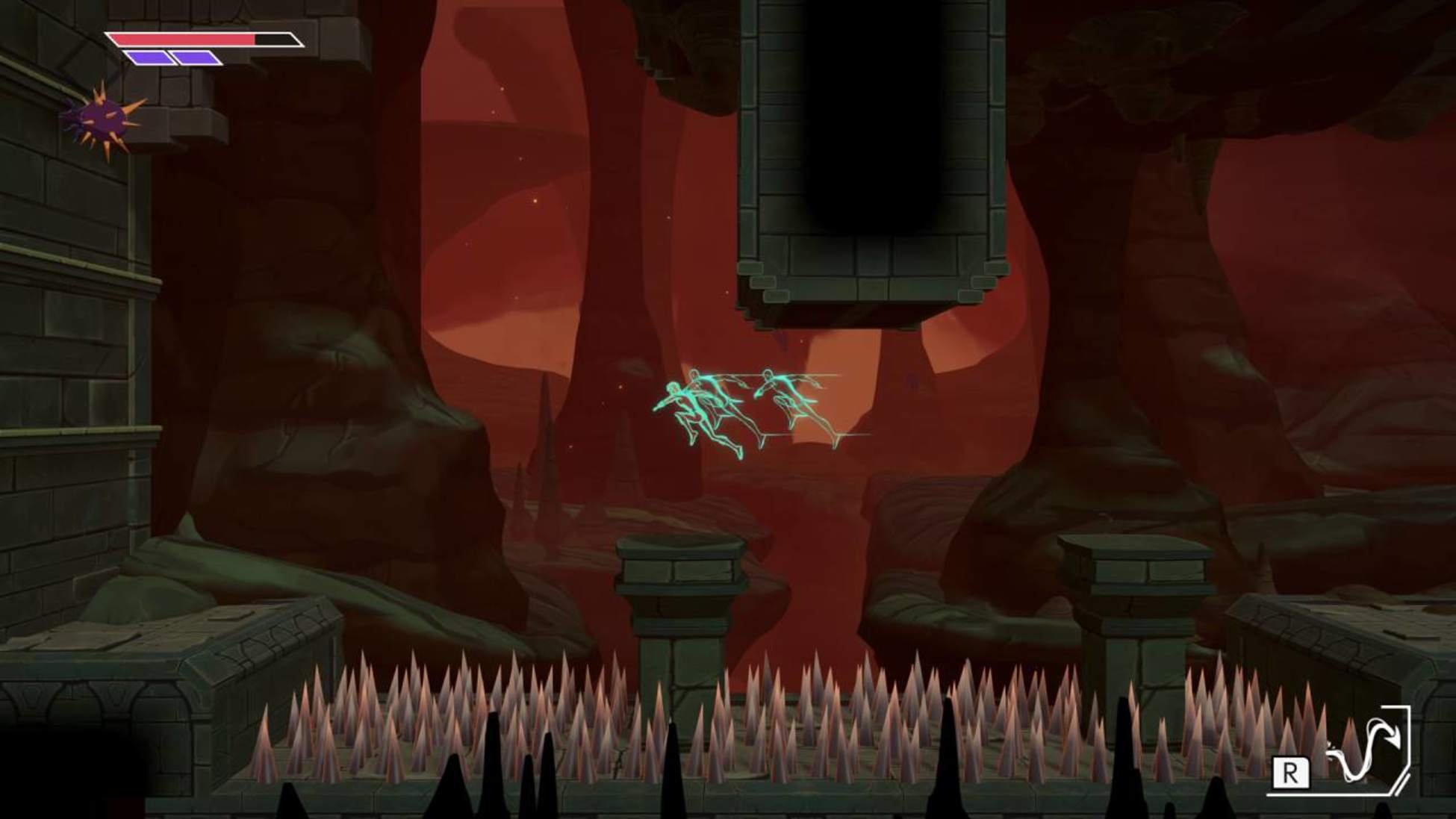
A lot of the platforming is done while attempting to avoid/eliminate enemies, and the controls aren’t necessarily conducive to handling everything at once. For example, aiming and running are both handled with the L stick, meaning you move to shoot in a certain direction. You can hold the L button to lock yourself in place while aiming/firing, but then you’re a stationary target. It’s quite frustrating until you learn to play the game on its terms.
There is the Psychogun, however, to alleviate some of that frustration. Fire this, and time stops while you draw its line of fire. You can bend it to take out multiple enemies, reach different levels, or even curve around walls.

Unfortunately, you can’t rely on it all the time. You’ll need to master your regular weapons, melee attacks, and avoidance skills to work through the game. And I do mean “master,” as there are considerable difficulty spikes and spongy enemies throughout, not to the meniton the numerous multi-stage boss battles. If you’re easily frustrated, Space Adventure Cobra – Awakening is not the game for you on any difficulty setting (two-player co-op can help, though).
That said, there’s more than enough here to drive you through to completion. The story is quite entertaining, and it zips along at the speed of the action itself. The battles are often way over the top. The characters are cool, too, and they work equally well in English and Japanese audio (other languages are available). I point that out because it’s quite rare in games of this type. Also because the subtitles are tiny, so English audio is probably the way to go, especially in handheld mode.
The visuals also carry their share of the load. The gameplay levels are a decent blend of simple graphics with modern effects, and they’re an acceptable transition from ’80s anime cutscenes. Too retro or too modern and it wouldn’t have worked.

I also like that the cutscenes haven’t been remastered in high def. They look like they would have on the 19″ CRT in your family’s den in 1982.
It all adds up to a title I enjoyed more for its style and story than gameplay. I think that’s actually a compliment, though; the developers seemingly have done a great job of capturing the look and attitude of the source material (not too hard to do when you’re actually incorporating said source material). It’ll certainly appeal to fans of the show and of retro anime in general. If that’s not you, you’re going to need plenty of patience and action-platforming experience to push your way through. As in your own adventures, exploding cigars will only get you so far.