The $17bn D2C market, the Esports World Cup and Pokémon Go’s 10th anniversary | Week in Views
Stay Informed
Get Industry News In Your Inbox…
Sign Up Today
The games industry moves quickly and while stories may come and go there are some that we just can’t let go of…
So, to give those particularly thorny topics a further going over we’ve created a weekly digest where the members of the PocketGamer.biz team share their thoughts and go that little bit deeper on some of the more interesting things that have happened in mobile gaming in the past week.

Craig Chapple
Head of Content
The truth behind mobile gaming’s $17bn D2C market
This week I published my video interview with Appcharge CMO Gil Tov-ly, covering all things direct-to-consumer and the company’s claims that the market is worth $17 billion.
Tov-ly reckons that’s a conservative estimate, particularly given the survey sample that the figure is based from. Many of these respondents, he said, were smaller studios compared to the big publishers that take the majority of mobile sales (and the significant D2C revenue they are making).

One key question I asked was whether it’s wrong for anyone to expect the market to grow bigger because of D2C. Is it just existing revenue being shifted to a new channel?
“I don’t know if I can get behind that,” said Tov-ly. “We often see a net revenue increase.”
He added: “On the web store front, we usually find that there’s a net gain. You don’t just shift transactional volume from place A to place B. You’re actually getting like a one plus one equals three type of situation. … It’s not just about shifting from one pocket to another. There actually is incremental growth oftentimes we see.”
One other interesting point to note, that I brought up in the interview, is how in the case of Modern Times Group, UA spend has risen in step with D2C.
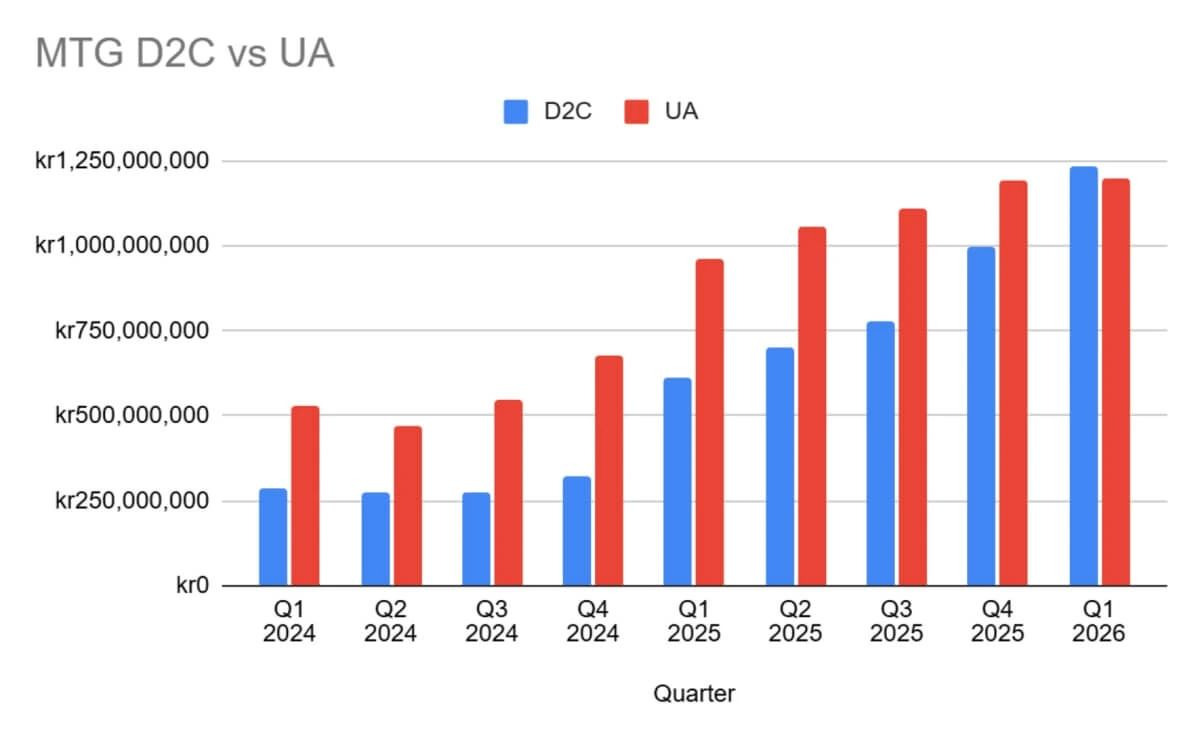
Check out the full interview for Tov-ly’s thoughts on that, the company’s D2C report and more.

Esports World Cup 2026 officially opens in Paris
This week marks the opening of the 2026 Esports World Cup in Paris, the first international edition of the event.
Over the next seven weeks, we’ll see more than 2000 players from over 100 countries competing across 25 tournaments in 24 different games, and on top of all that, there’s a massive $75 million prize pool up for grabs.
Originally, it was scheduled to take place in Saudi Arabia, but Paris was chosen due to concerns about the conflict in the Middle East. It also seems that organisers have expressed a desire to make it more global anyway, so perhaps this can serve as the start of a new format.
The scale certainly feels grand and I really like the idea of the Esports World Cup becoming a travelling event.
Giving different countries a chance to host the tournament is a fun idea and could be beneficial, as it should help keep things feeling fresh and may even help reach new audiences.
I hope the tournament is a big success. Competitive gaming has faced its fair share of challenges over the years, so I hope the Esports World Cup 2026 is a hit and can help pave the way for future iterations of the tournament and wider esports space.

Aaron Astle
Features & Data Editor
How Pokemon Go’s Ambassador Programme encourages community play
It was Pokémon Go’s 10th anniversary this week, marking a full decade since Pokémon trainers first took to the streets capturing old favourites in what quickly became an AR, geolocation hit.
Over those 10 years, AppMagic estimates suggest Go has made more than $9 billion between Google Play and the App Store, with likely even more player spending when you factor in the web shop.
This actually makes Go the fifth most-lucrative mobile game of the decade between the major stores. The only titles to surpass it were Honor of Kings, PUBG Mobile, Candy Crush Saga and Roblox.
In the context of millions of mobile games, landing in the top five over the course of a decade is no small accomplishment.
Meanwhile, according to official statistics, Go players have collectively walked more than 30 billion miles and, at least as of spring 2025, around 10 million people were still playing seven days a week.
To celebrate the 10-year milestone, I interviewed Pokémon Go ambassador Jupiter Hadley, who established the first official Pokémon Go community in Europe. She organises meetups for Go players, distributes in-game codes to reward those who are community-minded, gives out merch, and more.
A decade ago, you saw Go everywhere. Today, you don’t see players watching their phones and chasing rare spawns wherever you turn, but I do still encounter the odd person throwing Poké Balls out in the world.
For ambassadors, it sounds like an active community is alive and well. Hadley said Go is very much seasonal – with more players in the summer – but I was also intrigued to learn her meetups are more popular when there’s a meta-relevant Pokémon, rather than it being nostalgia-based.
A legendary casual player might not otherwise know, but with strong stats and moves in the Go meta, is going to draw more attention than a Charizard would just because it’s Charizard, for example. So it appears players 10 years in are focused on Go as its own entity rather than as nostalgia bait.
It’s fun to think back to that summer of 2016 when Pokémon was everywhere, especially as a fan of the series myself who wasn’t around for the original hype in the 90s. Suddenly, my friends and I went from the nerdy kids who ‘still hadn’t grown out of Pokémon’ to a group of experts ahead of the curve. I remember blowing a few excited minds as simply as saying, ‘oh yeah, that Pokémon has another evolution’, especially if it wasn’t in the game at launch.