TKO executives’ earnings concerning amid talent releases, contract resructurings
It’s Monday. Raw opens with the roar of a crowd and an explosive opening. The showcase of some of wrestling’s elite performers begins on Netflix.
Now it’s Tuesday, where the elite of the future are showcased on NXT in a more intimate setting.
It’s Wednesday, and you know what that means. It’s time for AEW Dynamite. Boom.
It’s Thursday, and it’s time for TNA. It’s Friday and it’s time for Smackdown, and now it’s the weekend, and it’s time for a premium live event or pay-per-view. Big money matches. Dream matches. Elite presentations.
So much of North American-based wrestling is tied up in the spectacle and majesty of that presentation, and around them, the moments in between that round out the totality of the experience. It’s the fun part we get to talk about, argue about, form strong opinions about based on what we like. And we do it all because we enjoy it. We’re not always going to agree 100% of the time, nor should we. You might disagree with everything I’ve said so far, and that’s fine. You might also disagree with what’s to come. That’s also fine.
Where the glitz, glamour, raw physicality and spectacle is what grabs our eyes and captures imaginations, the business side of wrestling can be a 180-degree about-face toward ugliness. It exposes us to the reality of contracts like it’s a pro sports league. Finances, corporatism, a wrestler’s value, and the discrepancies between what companies make in revenue versus how much of that goes to the wrestlers who actually drive the business with their passion and theatrics is central to this conversation.
There have been instances in the past where we saw what a handful of talent were making because those approximate terms were reported, and it usually came from uncorroborated hearsay. Obviously we also know bidding wars for talents are part of the game. The difference between those moments and now is we have touchstones to point to in the form of public disclosure of TKO executives’ payouts for the last fiscal year, the financial success of something like WrestleMania, and quickly thereafter, reports of talent releases despite that financial success. Where they did not occur, there were reports of contract restructurings.
The real concerning component is the potential of a release should those individuals not accept a restructuring. It would seem that’s what the former New Day members did, but we can’t know the breadth of the situation because a) those aren’t conversations we’re part of, and b) they’re our only actual example. We can only perceive the overall outputs, and opinions will naturally vary. In my view, that’s where respecting your own value in the case of being a wrestler is important, and for fans, respecting the value in what they do in the ring whether they’re in the second minute of a 5-minute match, or in minute 40 of an hour-long world title match.
I think it’s a fair comment to say that Vince McMahon’s ego and his attempts to maintain power in WWE both in the initial sale of WWE to what became TKO, and his efforts to rejoin the board before his final banishment have mortgaged WWE’s future. Given how TKO appears to treat talent with respect to releases, general ticket hikes that indirectly price out families, or even how they appear to value wrestlers’ work, I think the scope and perception of what WWE is has negatively shifted under TKO.
Has the wrestling business at the highest levels always been finance-focused? Obviously. There’s just something unsettling about watching a company “cut costs” on the back of record-breaking events that have led to key executives earning tens of millions of dollars in bonuses alone.
So before we proceed, ask yourself this. At this point, where would you rather see those bonuses go? To the talent, even if it’s just a portion to get one or two of those released talents back? Maybe to keep the New Day signed so they can ride out their careers where they arguably belong? Or to the pockets and bank accounts of TKO’s executives?
Summarily, who do you think is due that revenue? In light of what we know, did those talent releases need to happen? It’s a fair question.
TKO and WWE Executive Earnings
The recent disclosures need context, and we’ll use two examples for that. First we’ll look at what Vince McMahon earned annually when he ran the company as its majority stockholder until TKO assumed full ownership in late 2023. Then we’ll restate the WrestleMania sales figures from a previous column to recontextualize the subjective absurdity of why we’re even having this conversation.
According to SEC.gov filings, for the five years spanning 2018-2023 Vince McMahon earned a total of $100 million, which was predominantly made up by corporate compensation, payouts from his stocks and equity settlements. Annually he earned:
- 2018: $5.66 million (with a base salary of $1.4 million)
- 2019: $3.5 million
- 2020: $3.91 million
- 2021: $1.4 million (overall compensation was not disclosed due to executive pay freeze)
- 2022: $5.6 million ($2 million base)
- 2023: $7.6 million (employment agreement post-sale before company became TKO, consisting of a cash bonus, base salary and stock awards).
Compare to what we’ve seen, and it’s a little startling. If you’ve yet to, we’ll get to it in a moment. First for comparison’s sake, let’s look at Nick Khan’s reported income from the point he was hired in 2020 as President and Chief Revenue Officer.
- 2020: Base salary was approximately $1.2 million, combined with stock and equity bonuses.
- 2021: Base salary was $1.2 million. When you tack on stock bonuses and awards, his reported compensation eclipsed $5-6 million.
- 2022: Base salary increased to $1.35 million, but by July 2022 upon Vince McMahon’s resignation he became co-CEO; this led to his overall compensation topping $13 million.
- 2023: After being appointed sole CEO in January 2023, his salary was bumped to $1.5 million, and he received $15 million as a closing bonus due to the merger that resulted in the formation of TKO. Overall he earned $20 million.
- 2024: He resumed duties as WWE President after the closing of the merger and began earning $2 million annually.
- 2025: Compensation increased to $24.28 million, composed of his $2-million base salary, and about $21-22 million in cash bonuses and stock awards.
- 2026: As of May 2026, according to TKO’s SEC filings Khan will maintain a base salary of $2 million through to the end of the year, coupled with a 150% annual bonus worth $3 million in combination with equity bonuses. His earnings will again total around $24 million by the end of 2026.
Coupled with those filings for 2026 are details surrounding a contract extension through the end of 2026 that will see his annual base salary increase to $3 million in 2027. We’ll get to the most recent news in a moment. If you quickly compare their earnings year to year, you see two things:
- Although I’m sure McMahon probably earned more elsewhere, if we look at just reported earnings McMahon was not making relatively much in the years leading into the TKO merger.
- when you compare the years Khan and McMahon were both active in WWE, at least in terms of what we can see, Khan was coming out fairly well.
- After the merger, with McMahon on the outside, over the last two years Khan’s earnings have topped $24 million.
Before we proceed, as a reminder, these were the average ticket prices year-over-year for WrestleMania, as noted in a previous column.
- WrestleMania 37 (2021): $170-194 USD
- WrestleMania 38 (2022): $136-147 USD
- WrestleMania 39 (2023): $171-178 USD
- WrestleMania 40 (2024): $341-$348 USD
- WrestleMania 41 (2025): $635 USD
- WrestleMania 42 (2026): $1,500-1,700 USD
TKO Executive Earnings 2026
Following WrestleMania and the associated record-breaking sales, TKO released the company’s compensation figures for its key executives, and please keep McMahon’s own annual earnings in mind. Apologies if you’ve already been over these at this point, I know there are a lot of numbers flying around.
- Ari Emanuel, Executive Chair; Chief Executive Officer (CEO): Emanuel’s earnings topped $67.4 million, consisting of a $3 million base salary, 11.9 million in cash bonuses, and approximately $44 million in stock awards.
- Mark Shapiro, President; Chief Operating Officer (COO): Shapiro earned a total of $42.6 million, breaking down to a base salary of $4 million, $12.5 million in cash bonuses, and $25.8 million in stock awards.
- Nick Khan, WWE President: Tacking on to what was noted above, his $24.3 million earnings break down to a $10.75 million bonus and $11.5 million in stock awards combined with his base salary. Khan specifically will again see his base salary increase by 50% to $3 million in 2027, and from 2027-2030 (his contract duration) he will see his annual bonuses increase by 200% that will top him around $6 million. He also received an $11 million “signing equity award” and potentially a one-time $5 million incentive tied to Zuffa Boxing (which if you’re a longtime MMA fan, you’ll know “Zuffa” was the former controlling ownership company of UFC, primarily funded by the Fertitta brothers along with Dana White who is listed as a Zuffa Boxing promoter).
- Andrew Schleimer, Chief Financial Officer: Schleimer earned $23.1 million, including a $2 million base salary, $7 million in bonuses and $14.1 million in stock awards.
You can read the full report over at the Sports Business Journal. Another small note if you dive into the article, Dwayne Johnson received also received a $30 million award of what the article refers to as “restricted stock units,” $900,000 in licensing royalties, and was reimbursed $600,000 for travel expenses.
Just to reiterate, this was reported without even including Paul “HHH” Levesque’s contract as Chief Content Officer being extended over multiple years around WrestleMania 42, and how you perceive that is going to depend on how much you’re enjoying WWE programming. These terms have not been disclosed.
TKO Touts 2025 as a Knockout Success
When you consider the comparisons to what one of the key people in the company’s history earned in his final years and compare it against everything that was listed above, it’s a little startling on its own. What’s more concerning is how a company can tout tremendous successes in a fiscal year where TKO signed new rights deals with Netflix, USA network and the UFC’s deal with Paramount, in addition to a deal with ESPN for all of WWE’s premium live events.
Considering all of that, then how are the releases justifiable? The official logic behind the pay decreases stem from the wrestlers’ contracts being above market value, while the releases reportedly derived from the perception of value and potential use for each of those individuals. This probably won’t be the last time we talk about this topic either.
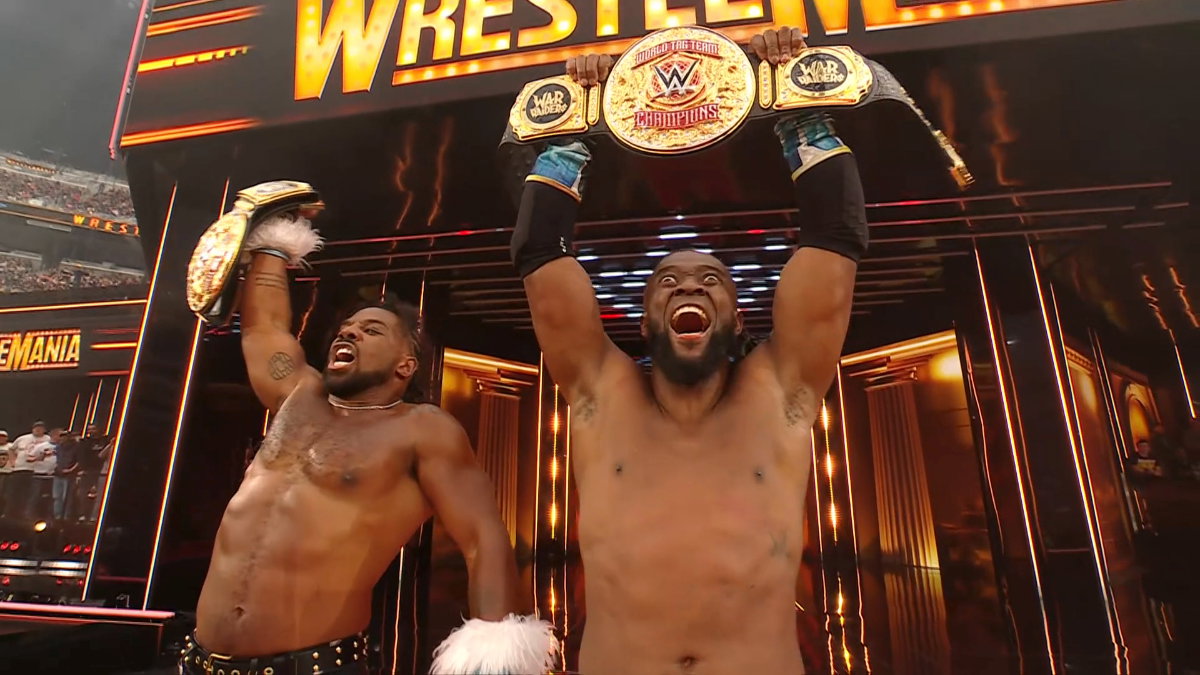
However, the departures of Kofi Kingston and Xavier Woods should be a moment for pause and concern about wrestlers’ compensation and the precedent this sets. Where they clearly valued themselves above what TKO believed their value was in 2026 in relation to their pre-existing contracts, the optics create a negative view of the company as a whole where we see all of these different financial metrics that indicate all of the executive brain trust are more than well compensated across WWE and UFC. Yet, talent’s jobs aren’t secure despite their contracts, and they can be asked to take a pay cut. And if they don’t, do they follow New Day out the door?
TKO as a whole is doing well. Meanwhile we see fighters and wrestlers — the ones risking their necks, knees, potential CTE and overall long term health — work for less. For example, a standard entry-level contract for the UFC is $10,000-$12,000 for fighting, and a matching win bonus that would double that pay. Even the mid-tier requires common fighters to win to eclipse $100K, which considering the company generated $4.735 billion in 2025 that should give you another moment of pause. Sure, there are performance bonuses, but not everyone gets those even when Dana White is overly generous on a given night. Most get what they get.
MMA, much like wrestling, is a high-risk, high-reward proposition. This is all to the paint the reality, or at least a perception of it, where TKO is very much seemingly operating on a model similar to what UFC had been doing under Zuffa LLC for years and applying that to WWE and Zuffa Boxing. It’s the entire reason I think we can even entertain this conversation as a talking point because the corporate ethos it seems is to maximize the earnings of those on top, who are at no point under any risk, while those who actually step into the rings and cages around the world risk their health, are commonly poorly compensated, or asked to take a pay cut.
This can’t be proven with any certainty, but it’s worth asking what would have happened to the people who chose to take 50% WWE pay cuts had they decided differently. Would they have quietly been shown the door without a word like Kingston and Woods? Would they have become “released independent contractor #7” on a list of 25? It’s all conjecture because it obviously didn’t happen, and we don’t know with any clarity who were offered and took paycuts to stay under the WWE umbrella.
The only inkling of information we have comes from Kevin Nash. On a recent episode of his podcast he said this:
“I’ve got enough moles in the business where I know the people that took 50% cuts. I know like one of the guys, and when I found out what the person was making, I just picked myself up off the ground that he was making that much money—and then realized that even at 50%, he was making huge money.”
There’s a lot to consider there. For one, if he knows, it’s probably only a matter of time before it becomes common knowledge. What you also have to consider is the person’s earnings relativity to what contracts are now, if they’re not main eventers as reported, and what the comparison is to what Nash defines as “huge money.” Is that based on what he knew when he was active, or at a minimum what he would probably be able to ballpark from what he would be privy to now? Keep in mind his WCW contract paid him $1-2 million a year. Also consider the possibility the person Nash speaks of is not necessarily the rule.
The people who have taken those cuts, whatever their reasoning have to understand the precedent that’s now been set for the future. And for TKO to set the value of what they deem you’re worth based on their metrics, but to then not even have a conversation with someone like Killer Kross last year who was ready with all of their metrics, is peculiar. This is again a moment for pause because there’s a disconnect in the logic on its own, contrasted against the corporate reports of what the top executives are earning.
Fighters and wrestlers are the lifeblood of these businesses, not the businesspeople. Executives earn their bonuses off the back of the performance of the companies and how those properties are valued. We see that in endorsements, licensing and events-based rights deals, but if you remove the professionals from the equation, who steps into the arena? Both have their place, but the last few months have demonstrated the discrepancy between what is earned by TKO/WWE executives, wrestlers, and both in relation to what is generated in revenue. I personally don’t think that’s arguable, but you’re free to disagree.
To close I’ll leave you with one question: if you were presented with the same question as those WWE roster members, what would be your decision? Take the cut? Or potentially be released?
Your answer, whatever it is, has been the point.