Scott Pilgrim, The Ramones, and the many other influences behind indie gem Wax Heads

When we play videogames, we’re often seeking transportation to a completely new world, filled with stories that we’d never encounter in real life. But sometimes, games are just as effective when they recreate hyperspecific experiences in our day-to-day lives. That’s exactly how Wax Heads makes me feel with its depictions of the DIY music and record store scenes.
This beautiful indie game had a hold of me from the moment I played its demo, and, as you can see from my full Wax Heads review, my connection to it only got stronger the more I played. So, of course, I had to get inside the heads of the people responsible for bringing Repeater Records to life.
I got the chance to interview Murray Somerwolff and Rocío “Rothio” Tomé, the two creative minds who make up Patattie Games and the development of Wax Heads. I asked them about the process of making such a game, their artistic influences, and their own experiences in the world of music.
Pocket Tactics: Everything about Repeater Records is immersive. How did you create such a wide variety of bands, artists, and albums that all feel like they could be real, while keeping the genres so varied?
Murray Somerwolff: I love painting detail into the worlds I create. Not in an obsessive “lore” sort of way, but more in a tactile, immersive way, where the space feels alive and breathing, somewhere you could actually imagine standing in and touching – so I’m very glad to hear you say Repeater Records feels immersive!
In the case of doing this with Wax Heads, I think the trick was to try and not parody or imitate reality (i.e., not making a band called “The Fleas” instead of The Beatles) and rather amalgamate a group of references that focus on a feeling I want to convey.
To give an anecdote, we have this artist called Roberta D in Wax Heads. She’s an avant-garde, electronic artist who is a bit inspired by Björk in her outlandishness, but she also has the pretentiousness and mystery of someone like Aphex Twin or Burial. I don’t try to make any of these connections explicit; it’s more the personal relationship I have to those artists and the feelings they give me that allow me to mash them together and make something new.
I think it’s just a genuine joy with my relationship to music and storytelling that allows me to keep this world of interconnecting fictional bands in my head.
As someone who hangs out in the DIY music scene a lot, it’s clear how much of an impact that world has had on Wax Heads. Do you have any favorite memories from local gigs, or any that inspired events in the game?
MS: Oh, so many! I remember going to this gig in London, I hadn’t been living there long, and I saw Abe Vigoda / Male Bonding and No Age all play, and the electricity in that room was incredible. One of those moments of just a mass of limbs in noisy ecstasy.
I remember playing with a gig with one of my old bands, friends from secondary school, we all moved to London together and had played too many bad gigs, but we played this one set at The Shacklewell Arms and all our friends came, the place was packed and we played the best we ever played (…players may or may not find evidence of this to judge themselves in the game) and that rush of just locking into the fuzz of the bass, guitar, drums and vocals in front of a crowd of familiar faces, there’s a reason why I still hold that night in high esteem.
The last one I’ll mention is that I went to this all-day event by this organizer called Fluffer Pit Parties. They would do 360-degree shows where the band plays in the middle with the audience all around. I went to one of these and saw a host of awesome bands like Bo Ningen and Black Lips, and other smaller, local bands. But I remember coming out for some air, and it was a warm, sticky day and it was sunny, but also it had that smoggy haze that London has, but for some reason in that moment it all felt cathartic, like just the adrenaline of being in a room with people witnessing these bands go all out, I remember leaning outside and enjoying that glimpse of feeling anything was possible. That energy 100% fuels Wax Heads.
Even from the demo, the accessibility options in the game are really in-depth. How did accessibility factor into your development process?
Rocío “Rothio” Tomé: Accessibility has always been really important to me personally, and Murray and I were aligned on that from the start. My background is in psychology and neuropsychology, so I was very focused on making sure we did things properly from both a design and technical point of view.
Of course, adding accessibility features did make development more complex and increased production time in some areas, but we felt it was worth it because it means more people can enjoy the game. There are definitely moments during development where you wonder if the extra effort is justified, but seeing players who otherwise might struggle with the game being able to enjoy it fully really confirms that it was the right decision.

Specifically, why did you decide to add a redo feature?
RT: It was a feature we added in the later stages of development after I raised a concern with Murray about how frustrating it can be when you’re not fully sure about the correct answer in puzzle-based gameplay.
I made a small prototype where players could adjust their answer if it wasn’t perfect, and we quickly saw that it worked really well. It created an alternative way to play that could help not only people who struggle with the puzzles themselves, but also anyone who prefers a different rhythm or approach.
In the end, we really like the idea of adapting the game to the player, rather than forcing the player to adapt to the game. It can be especially helpful when someone finds the puzzle challenge too difficult, or when they have a lower tolerance for frustration, so they can still enjoy the experience in a way that works for them.
The cartoonish art in this game is phenomenal and very visually distinct. Who or what has influenced your artistic style over the years?
MS: First off, thank you for the kind words! I originally started out as an illustrator before I got into games, and I’ve got this particular style I’ve grown into. It all comes from being super fortunate to have had Sky as a kid, so I grew up on 90s cartoons that have absolutely infected my brain; Dexter’s Lab, Aaargh Real Monsters, Samurai Jack, Rocko’s Modern Life, etc., and that mixed with a love for the Beano, has really given me my illustrative personality.
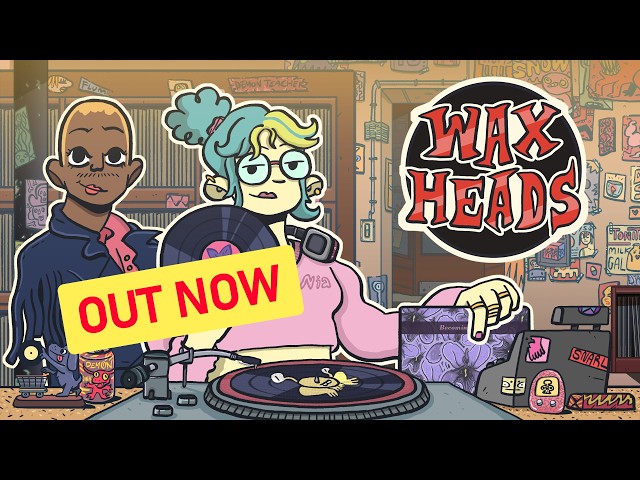
All that being said – when it came to Wax Heads, I really wanted to give it a particular stylistic identity and after exploring different approaches, it was when I was looking at my Scott Pilgrim comics, and I realised that Bryan Lee O’Malleys big chunky, slick comic art was the perfect inspiration for a record store game, that I felt that distinct voice for Wax Heads click into place.

Are there any music scenes or moments in history in particular you leaned on to inspire the game, such as the Seattle Grunge scene?
MS: I think there are lots of scraps of different scenes and moments in my mind, which all glue together in my head like a quilted patchwork. I enjoy reading about music, and books that were particularly influential for Wax Heads were Please Kill Me: The Uncensored Oral History of Punk, which is a wild read of anecdotes about Velvet Underground, The Ramones, Iggy Pop, Television, etc., and captures a lot of that bubbling-underground-going-mainstream culture shock, as well as Girl in a Band, Kim Gordon’s autobiography.
Then there’s my time in London in the 2010s, playing in bands and trying to cut my own teeth in the explosion of garage rock and scuzzy bands like Male Bonding, Black Lips, Eagulls. I think the idea of Wax Heads was to try and channel all these influences and interests into a stream of music consciousness that gives our game authenticity, while avoiding being too time-specific.
How important was it to you to include punk and leftist images and ideas in the game?
MS: I would say it was very important to champion and celebrate the social justice and inclusive elements of punk and subculture communities. Especially because punk is such an elastic word. It’s been used to both label those who challenge authority, but also for some of the more hateful aspects of humanity, like extremist or problematic groups.
So we wanted to leave no room for interpretation, that when we’re expressing punk in our game, we’re talking about the power of activism, community, and support. Especially in being inclusive. From the very beginning, we have wanted Repeater Records to feel like a welcoming space that rewards passion and joy, a place that anyone should feel welcome in.
And it’s maybe worth adding that the game is a personally charged project, so it does very much represent our values and ideas that we wish were included more regularly in our society’s day-to-day vocabulary.

How did you go about making the setting of a record store relatable to people who’ve potentially never set foot in one?
RT: It’s actually funny to me that this question comes up because it’s kind of my case personally. It’s not that I’ve never been in a record store or vinyl shop at all, Murray even took me to a few in London so I could get a better sense of the music scene, but I’m also someone who really enjoys silence, and I don’t have a strong personal background in music culture.
Even so, Murray has been able to create bands and a world that feel completely real without needing to strictly rely on existing real-life references. The game is more about culture, music, and a sense of community than it is about knowing specific bands. And I think that’s the key point, you don’t need to be a music expert to get into it. You just need to be open to stepping into a world built around shared interests and curiosity.
The record store experience is much more than just buying vinyl. What parts of that experience did you feel you had to implement in the game?
MS: I think the magic of discovery and possibility in a space. I love record stores because they invite you to look and explore. The kaleidoscope of album covers pulls you from one end to the other. You’ll instinctively pick something up because it looks cool, even though you have no idea what it is.
It was so important that that experience was channeled into Wax Heads, that there was an innate joy just in looking through the rooms and looking at the covers, even as you’re trying to help recommend something specific to a customer. It projects the idea of possibilities and unbridled experiences that are just waiting for you to give them a chance.
I think that, and also the tactile quality. Being in a record store is a physical experience, so it was vital to try and replicate the sensation of touching things, whether that be the way the table shoots up to investigate a record, the way you can flip and switch between records, or navigate the store. Despite being in a digital world, we wanted to try to make Repeater Records feel like a place you’re actually meaningfully interacting with.
What does the future hold for Patattie Games?
Both: Games! More games! We do have to be patient, though, as at the moment our main attention is on Wax Heads, and depending on how healthy the launch is, there are some ideas we would love to still explore.
We are in no short supply of thinking about what other new worlds we would want to explore, and they go in some quite surprising directions. It’s gonna be fun to see how people react when we get to that stage.
If you want to give running a record store a try, you can grab Wax Heads for the Nintendo Switch or Steam Deck right now. It’s a wonderful mixture of puzzle games and cozy games, and I cannot recommend it enough.